
Dr Katharine Fussell Wigan's first female surgeon star in Wigan, Greater Manchester, England, UK.
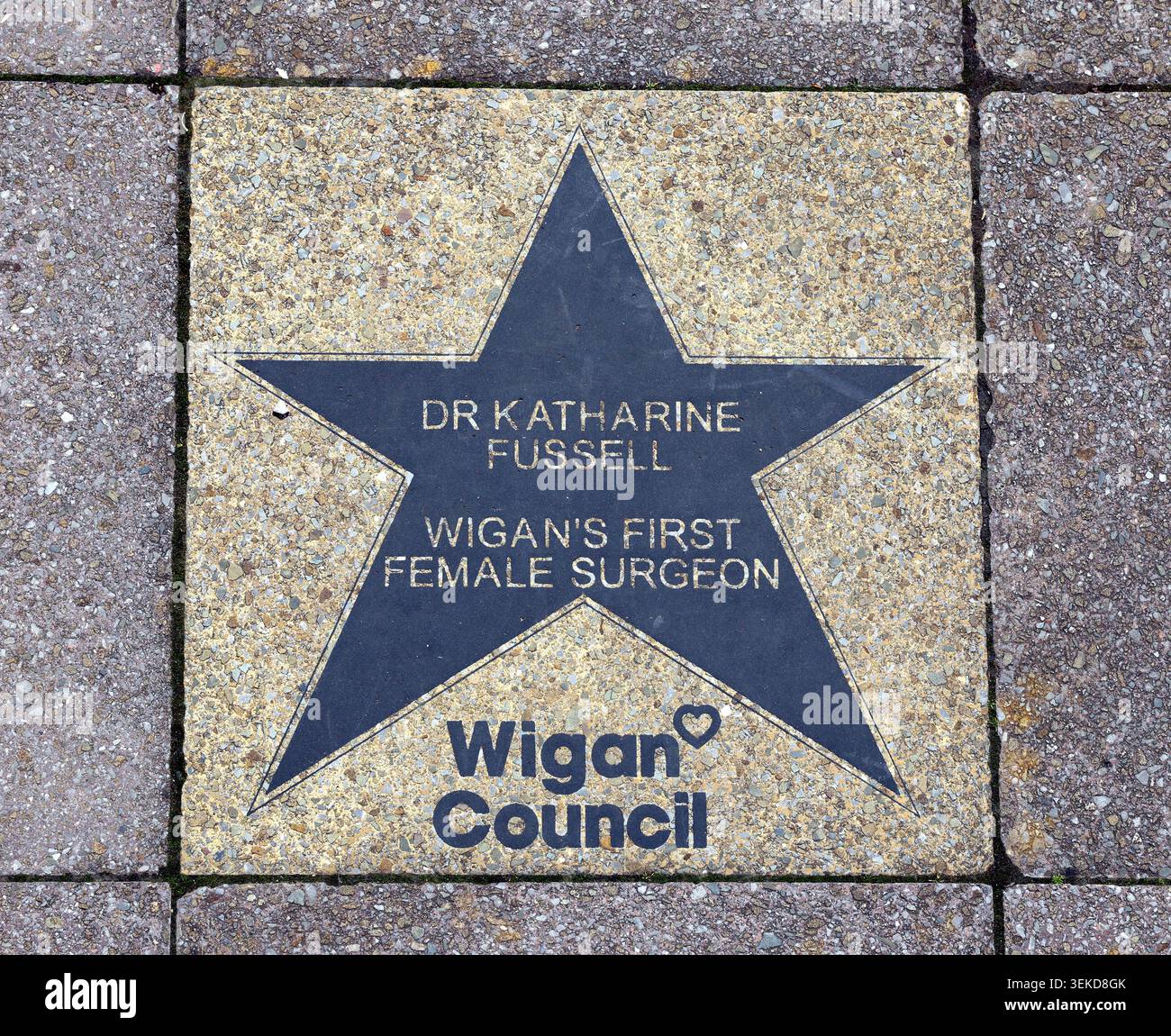
Image details
Contributor:
Tony SmithImage ID:
3EKD8GKFile size:
82.9 MB (8.8 MB Compressed download)Releases:
Model - no | Property - noDo I need a release?Dimensions:
5960 x 4860 px | 50.5 x 41.1 cm | 19.9 x 16.2 inches | 300dpiDate taken:
6 May 2026Location:
Wigan town centre, Greater Manchester, England, UKMore information:
. Dr Katharine Fussell Wigan's first female surgeon star in Wigan, Greater Manchester, England, UK. Photographed on 6 May 2026. The recorded location is Wigan town centre, Greater Manchester, England, UK. The pavement memorial uses a blue star design with Wigan Council branding and identifies Fussell as an important figure in local medical history. The close-up format clearly records the inscription and offers a useful visual for stories about women's professional achievements, the history of surgery and healthcare, local role models and the recognition of notable people associated with Wigan. Seen through town centre, the earlier context is that town and neighbourhood images record the accumulation of ordinary change: road layouts, shop names, signage, public art and building uses; Their value increases when compared over decades because apparently minor details can become the clearest evidence of transformation. For biography, the historical context is that biographical landmarks are especially valuable where the original person or activity is no longer present, preserving a geographic connection between cultural history and place. Looking at MRI, the longer history is that the National Health Service, founded in 1948, created a universal healthcare system whose hospitals, ambulances, clinics and public-information campaigns became familiar features of British life; Medical technology has continually changed the appearance of those services. The 2026 relevance of town centre comes from the fact that current place-making policy increasingly emphasises distinctive local identity rather than generic development, so small landmarks and community businesses can become important parts of how an area is represented. For biography, the 2026 context is that cultural tourism increasingly uses plaques, trails, murals and public art to connect visitors with writers, actors and musicians associated with a place.

