
All Saints parish Church and Wigan War Memorial under bright clouds in the historic centre of Wigan, Greater Manchester.
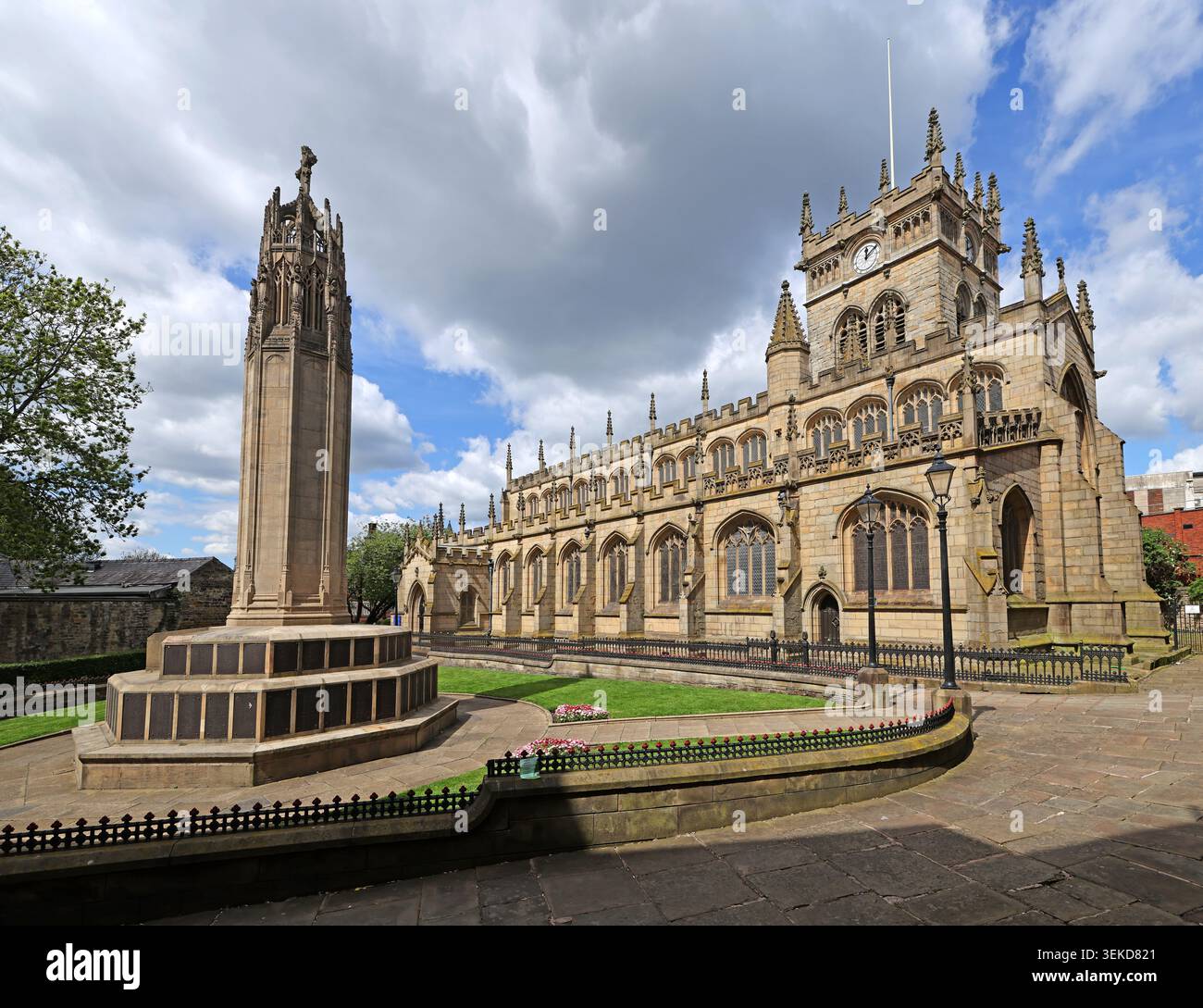
Image details
Contributor:
Tony SmithImage ID:
3EKD821File size:
96 MB (4.4 MB Compressed download)Releases:
Model - no | Property - noDo I need a release?Dimensions:
6604 x 5079 px | 55.9 x 43 cm | 22 x 16.9 inches | 300dpiDate taken:
6 May 2026Location:
All Saints Church, King of Prussia Yard, Wigan WN1 1NLMore information:
Sunny documentary photograph shows Wigan Parish Church, formally All Saints Church, with Wigan War Memorial standing in the landscaped churchyard in the town centre. The view brings together two important civic and heritage landmarks: the Grade II* listed parish church on Wallgate and the tall Portland stone war memorial commemorating local people who died in the First World War and later conflicts. All Saints is one of Wigan’s most historic buildings, with the National Churches Trust noting that it is by far the oldest church in Wigan and that the earliest possible reference to a church in Wigan appears in the Domesday Survey of 1086. Historic England lists the Church of All Saints at Grade II*, while architectural accounts describe major nineteenth-century rebuilding by Sharpe and Paley, with later tower work by E G Paley. The war memorial was designed by Sir Giles Gilbert Scott and the Imperial War Museums place it at All Saints Church, King of Prussia Yard, Wigan WN1 1NL. The photograph is useful for editorial features on Wigan, remembrance, war memorials, church architecture, listed buildings, local history, civic identity, Lancashire heritage, Greater Manchester tourism, public monuments and the continuing role of parish churches in town-centre life. The stone church, pinnacled tower, arched windows, iron railings, flower beds, paving and dramatic cloud-filled blue sky give the image a strong sense of place and weather. It could support articles about Remembrance Sunday, First World War commemoration, Second World War memory, historic conservation, ecclesiastical architecture, visitor trails, town-centre regeneration, local pride, military sacrifice and the way northern towns preserve public memory through churches, monuments and civic landscapes.

