
Roman gladiator Golden Balls figure at Bulldog Forge in Ince, Wigan, Greater Manchester, England, UK.
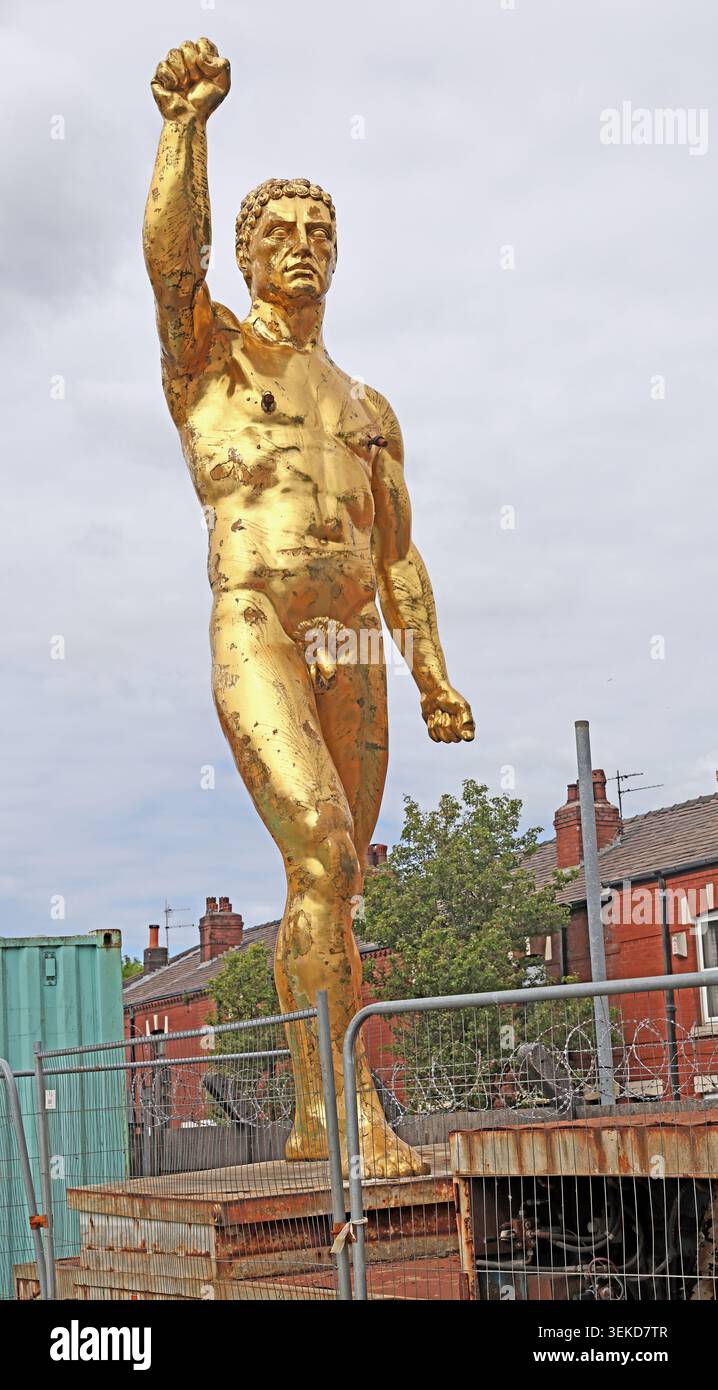
Image details
Contributor:
Tony SmithImage ID:
3EKD7TRFile size:
81.8 MB (2.9 MB Compressed download)Releases:
Model - no | Property - noDo I need a release?Dimensions:
3976 x 7192 px | 33.7 x 60.9 cm | 13.3 x 24 inches | 300dpiDate taken:
6 May 2026Location:
Bulldog Forge, Ince, Wigan, Greater Manchester, England, UKMore information:
. Roman gladiator Golden Balls figure at Bulldog Forge in Ince, Wigan, Greater Manchester, England, UK. Photographed on 6 May 2026. The recorded location is Bulldog Forge, Ince, Wigan, Greater Manchester, England, UK. The unusual gold-painted male figure stands with one arm raised and has become a distinctive local roadside landmark associated with the former industrial forge site. Often nicknamed Golden Balls, the muscular Roman-style figure provides a striking contrast with the industrial surroundings and has the character of vernacular public art rather than formal civic sculpture. The historical setting for factory is that industrial heritage links architecture and machinery with the people who worked in mines, potteries, foundries and factories; As production declined or modernised, many sites were demolished, adapted or preserved as museums and regeneration projects. Seen through consumer culture, the earlier context is that everyday objects often become better historical evidence with age because packaging, typography, materials and branding evolution more rapidly than their basic function; Souvenirs, games and household items can therefore date consumer culture very precisely. For place-making, the historical context is that town and neighbourhood photographs record the accumulation of ordinary change: road layouts, shop names, signage, public art and building uses; Their value increases when compared over decades because apparently minor details can become the clearest evidence of transformation. In the 2026 discussion of factory, industrial heritage is increasingly tied to regeneration, tourism, conservation and skills education, particularly in former manufacturing towns seeking new uses for historic sites. The 2026 relevance of consumer culture comes from the fact that sustainability and reuse also give older objects new relevance, encouraging repair, second-hand sales and appreciation of durable material culture.

