
NHS Warrington MRI Centre entrance sign at Warrington Hospital, Cheshire, England, UK.
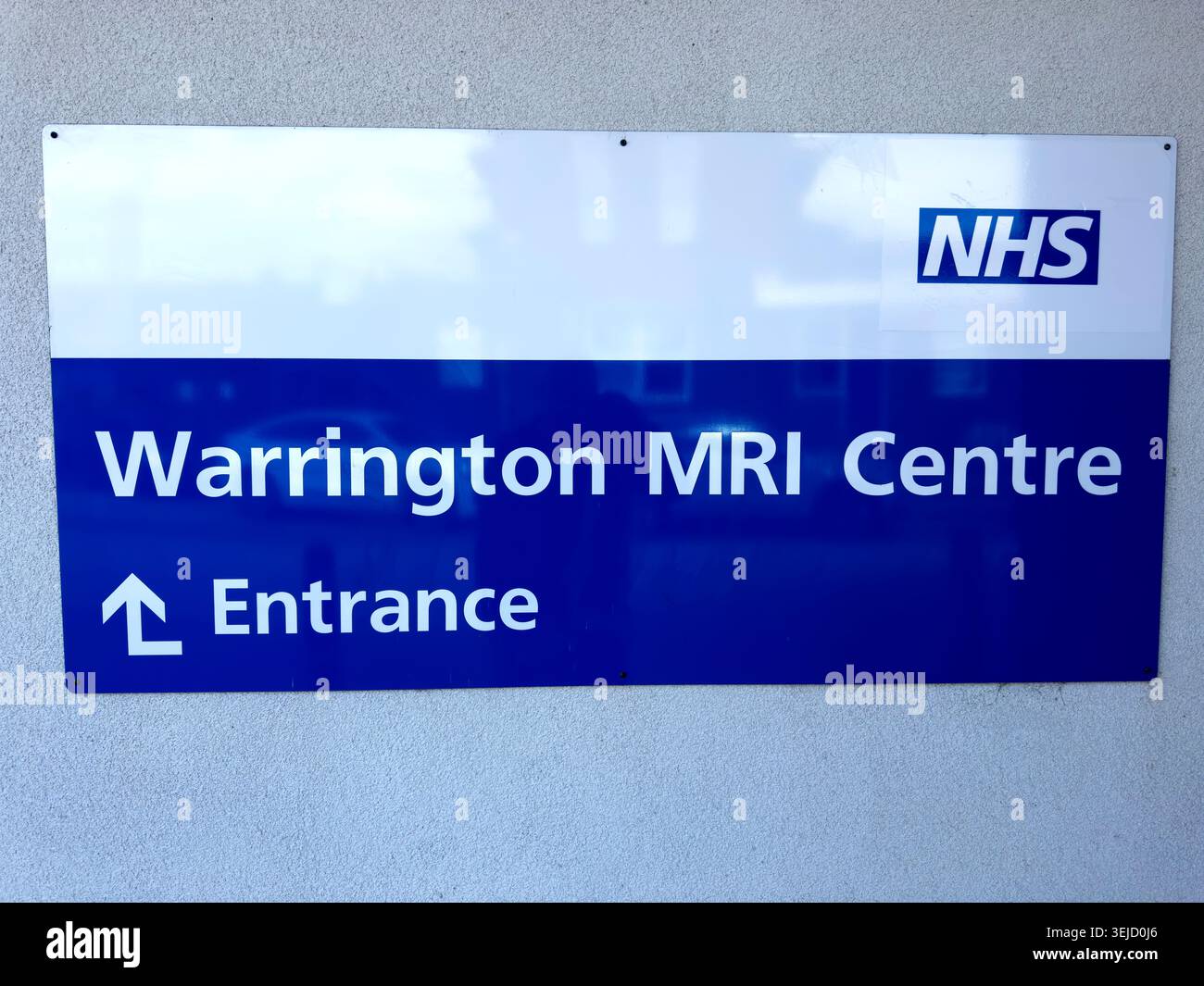
Image details
Contributor:
Tony SmithImage ID:
3EJD0J6File size:
86.9 MB (3 MB Compressed download)Releases:
Model - no | Property - noDo I need a release?Dimensions:
6364 x 4773 px | 53.9 x 40.4 cm | 21.2 x 15.9 inches | 300dpiDate taken:
28 April 2026Location:
Warrington Hospital, Lovely Lane, Warrington, Cheshire, England, UKMore information:
. NHS Warrington MRI Centre entrance sign at Warrington Hospital, Cheshire, England, UK. Photographed on 28 April 2026. The recorded location is Warrington Hospital, Lovely Lane, Warrington, Cheshire, England, UK. The blue and white directional sign identifies the MRI imaging facility and points patients and visitors towards the entrance. Magnetic resonance imaging is widely used to create detailed images of organs, soft tissue and other structures without using ionising radiation. The close view of the NHS-branded sign provides a clear generic healthcare image for stories about hospital waiting lists, diagnostic capacity, investment in scanners, cancer and neurological diagnosis, medical appointments and pressures on NHS diagnostic services. For the story of medical technology, it is useful to note that the National Health Service, founded in 1948, created a universal healthcare system whose hospitals, ambulances, clinics and public-information campaigns became familiar features of British life; Medical technology has continually changed the appearance of those services. The historical setting for signage is that wayfinding developed from painted names and fingerposts into standardised road, rail and public-information systems; Local signs still retain distinctive typography or bilingual wording even within increasingly consistent national standards. Seen through streetscape, the earlier context is that place-based photography helps document the relationship between named locations and the people or businesses associated with them, especially where formal architectural records are limited. For present-day medical technology, 2026 is significant because seasonal vaccination continues to be a major public-health tool , particularly for influenza and respiratory illness among higher-risk groups; Campaign material illustrates how health services encourage uptake through everyday communication.

