
WRECSAM landmark sculpture in Queen’s Square with Wrexham’s restored Old Carnegie Library behind it.
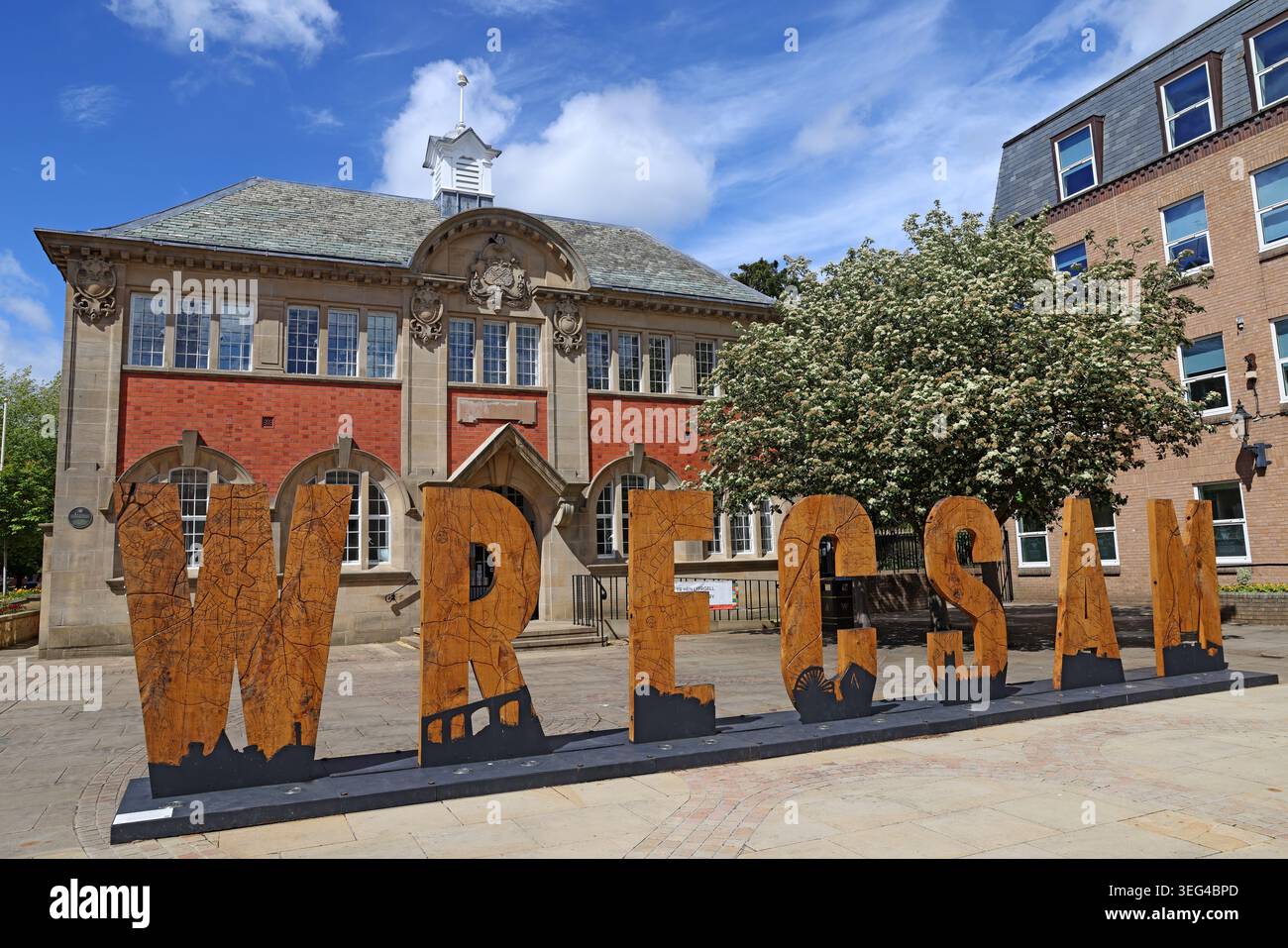
Image details
Contributor:
Tony SmithImage ID:
3EG4BPDFile size:
128.1 MB (6.3 MB Compressed download)Releases:
Model - no | Property - noDo I need a release?Dimensions:
8192 x 5464 px | 69.4 x 46.3 cm | 27.3 x 18.2 inches | 300dpiDate taken:
17 May 2026Location:
The Old Library, Queen’s Square, Wrexham, North Wales, Wales, UK, LL11 1ATMore information:
Large freestanding letters spelling WRECSAM, the Welsh-language name for Wrexham, stand in Queen’s Square outside the historic Old Library in Wrexham city centre, North Wales. The rust-coloured sculptural installation creates a prominent civic landmark and photographic attraction, celebrating the city’s identity, language and growing profile as a visitor destination. The photograph shows the complete sign beneath a bright blue summer sky with scattered white clouds. Behind the letters is the former Carnegie library, an attractive red-brick and stone building with arched ground-floor windows, decorative masonry, a central entrance and a small rooftop cupola. Mature trees in flower frame the square and soften the surrounding city-centre architecture. No people are visible, allowing the WRECSAM lettering and historic building to dominate the composition. The Old Library was originally funded by Scottish-American philanthropist Andrew Carnegie and opened as Wrexham’s public library in the early twentieth century. The Grade II listed building later stood closed to the public for many years before undergoing a multimillion-pound refurbishment as a creative industries hub. Its reuse combines heritage conservation with contemporary cultural and economic activity in the heart of the city. The large WRECSAM letters were unveiled in Queen’s Square as a public artwork and temporary landmark intended to celebrate local identity, encourage photographs and promote destinations across Wrexham County Borough. Their use of the Welsh spelling reinforces the area’s bilingual culture and provides a striking example of place branding within an improved public realm. The image is suitable for editorial coverage of Wrexham tourism, Welsh identity, public art, bilingual placenames, urban regeneration, Carnegie libraries, listed buildings, creative industries, civic pride, city-centre improvement and the promotion of North Wales visitor destinations.

