
West Midlands Police car reflected in the glass frontage of Birmingham New Street station, England, UK.
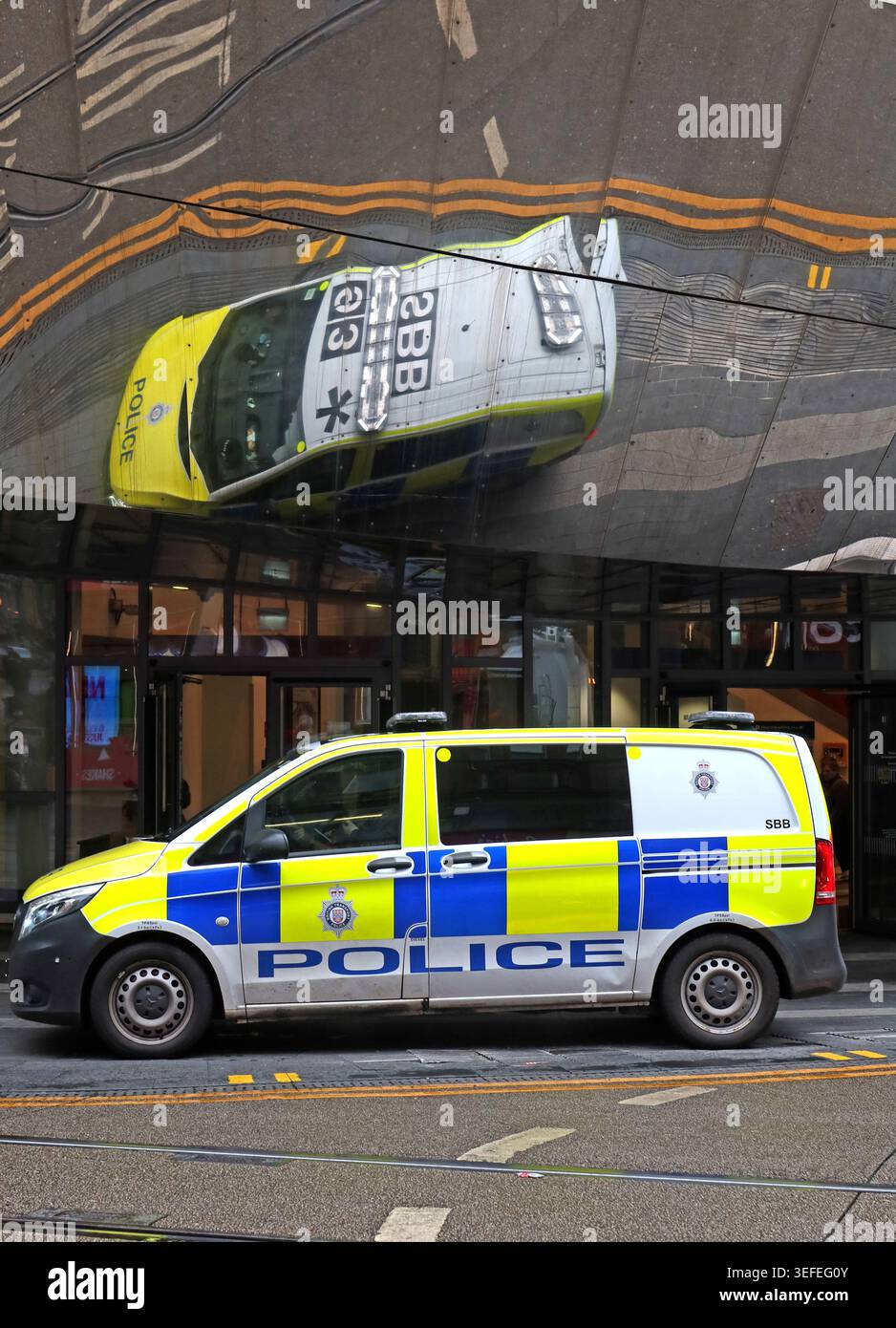
Image details
Contributor:
Tony SmithImage ID:
3EFEG0YFile size:
52.7 MB (2.1 MB Compressed download)Releases:
Model - no | Property - noDo I need a release?Dimensions:
3648 x 5052 px | 30.9 x 42.8 cm | 12.2 x 16.8 inches | 300dpiDate taken:
2 October 2023Location:
Birmingham New Street station, Birmingham, West Midlands, England, UKMore information:
. West Midlands Police car reflected in the glass frontage of Birmingham New Street station, England, UK. Photographed on 2 October 2023. The recorded location is Birmingham New Street station, Birmingham, West Midlands, England, UK. The marked yellow and blue police vehicle is parked beside the station while the distinctive reflective facade creates a mirrored view above it. Major stations are regularly policed because of their high passenger numbers and importance as transport hubs. In relation to law enforcement, historical context shows that courts and police buildings are physical expressions of the justice system; Their entrances, crests and signs identify the institutions responsible for criminal and civil proceedings, public order and local administration. For the story of AA, it is useful to note that road accidents and damaged vehicles are part of the history of road safety, prompting improvements in vehicle design, seat belts, speed management, emergency response and highway engineering. The historical setting for rail heritage is that stations are both functional transport interchanges and pieces of civic architecture; Their canopies, footbridges, booking halls, signal boxes and signage reveal how passenger expectations and railway technology changed from steam-era operation to today's increasingly digital network. As of 2026, the position for law enforcement is that courts and policing remain closely linked to debate about access to justice, case backlogs, community safety, estate modernisation and public-service funding; Photographs of buildings and signs can illustrate the institutional setting without implying details of any individual case. For present-day AA, 2026 is significant because road safety remains a major policy concern , while modern vehicles add sophisticated driver-assistance systems without eliminating collisions or the need for recovery services.

