
Piccadilly Arcade entrance on New Street in Birmingham city centre, West Midlands, England, UK.
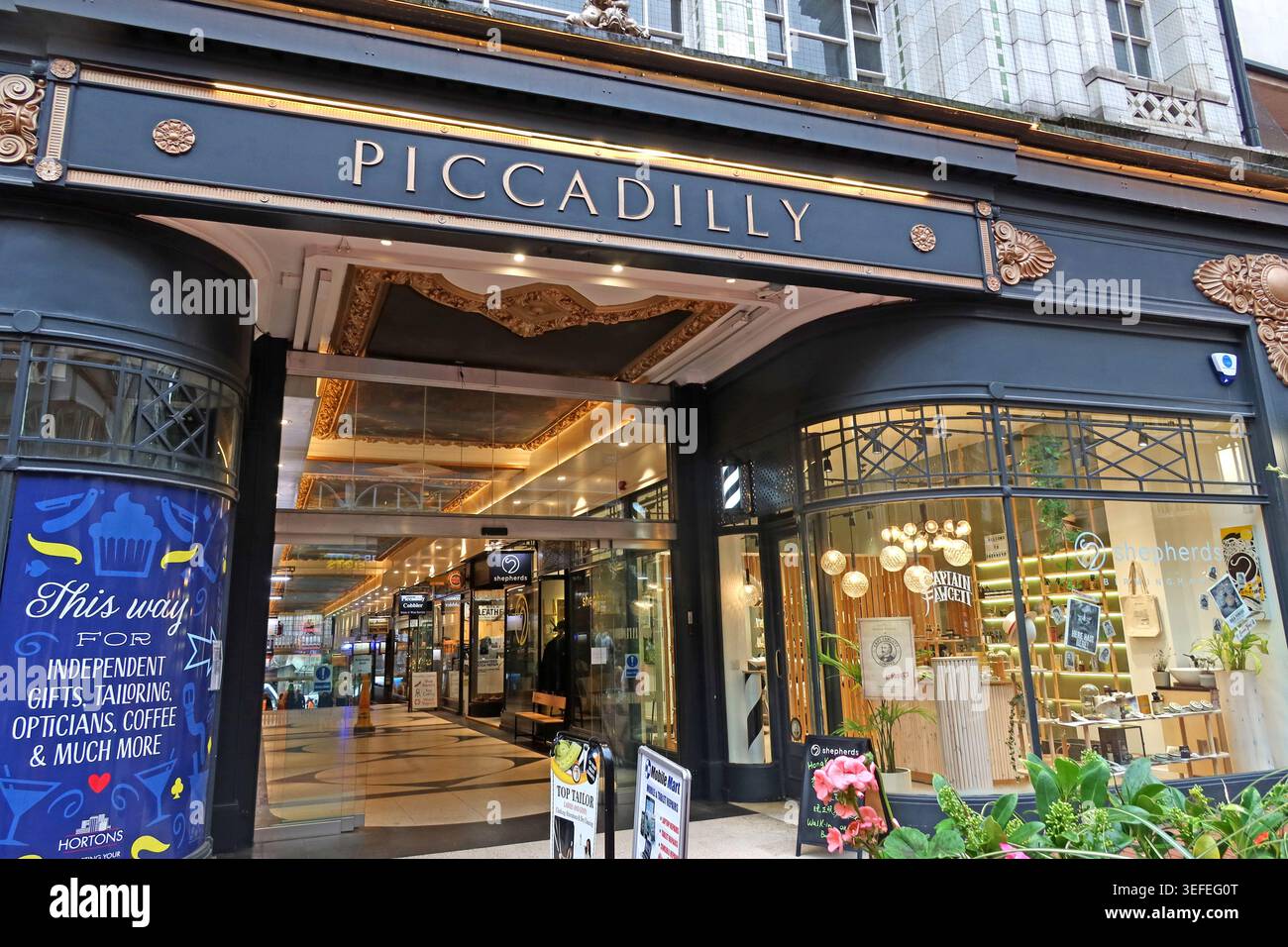
Image details
Contributor:
Tony SmithImage ID:
3EFEG0TFile size:
57.1 MB (2.5 MB Compressed download)Releases:
Model - no | Property - noDo I need a release?Dimensions:
5472 x 3648 px | 46.3 x 30.9 cm | 18.2 x 12.2 inches | 300dpiDate taken:
2 October 2023Location:
Piccadilly Arcade, New Street, Birmingham, West Midlands, England, UKMore information:
. Piccadilly Arcade entrance on New Street in Birmingham city centre, West Midlands, England, UK. Photographed on 2 October 2023. The recorded location is Piccadilly Arcade, New Street, Birmingham, West Midlands, England, UK. The dark blue and gold shopfront-style entrance carries prominent PICCADILLY lettering and leads into a covered pedestrian shopping arcade lined with independent businesses. The traditional entrance provides a clear identifying view of one of Birmingham's smaller shopping passages and can illustrate stories about specialist retailers, city-centre footfall, heritage shopping, high-street change and the survival of historic arcades within a modern commercial district. The historical setting for urban design is that the built environment is continually reused; Warehouses become apartments, stations become event spaces and commercial premises acquire new occupants, making older photographs particularly useful for tracing regeneration, demolition, conservation and adaptive reuse. In the 2026 discussion of urban design, reuse of existing buildings is increasingly discussed alongside embodied carbon, heritage conservation and town-centre regeneration; Photographs of older façades and converted premises can illustrate the practical tension between preservation, energy performance and new development. Additional high-relevance terminology includes architectural detail, historic building, facade, streetscape, heritage building, construction, property, townscape, cityscape, architectural history, building conservation, IMG_1888, architecture, and tourism. Seen through construction, the earlier context is that architecture records the priorities of the period in which a structure was designed: materials, ornament, scale and planning reveal technology, status and intended use; Later alterations, extensions and new tenants add further layers, so a single façade can embody several phases of local past.

