
Dohány Street Synagogue, the Great Synagogue of Budapest, with Moorish Revival facade and twin towers in the Jewish Quarter.
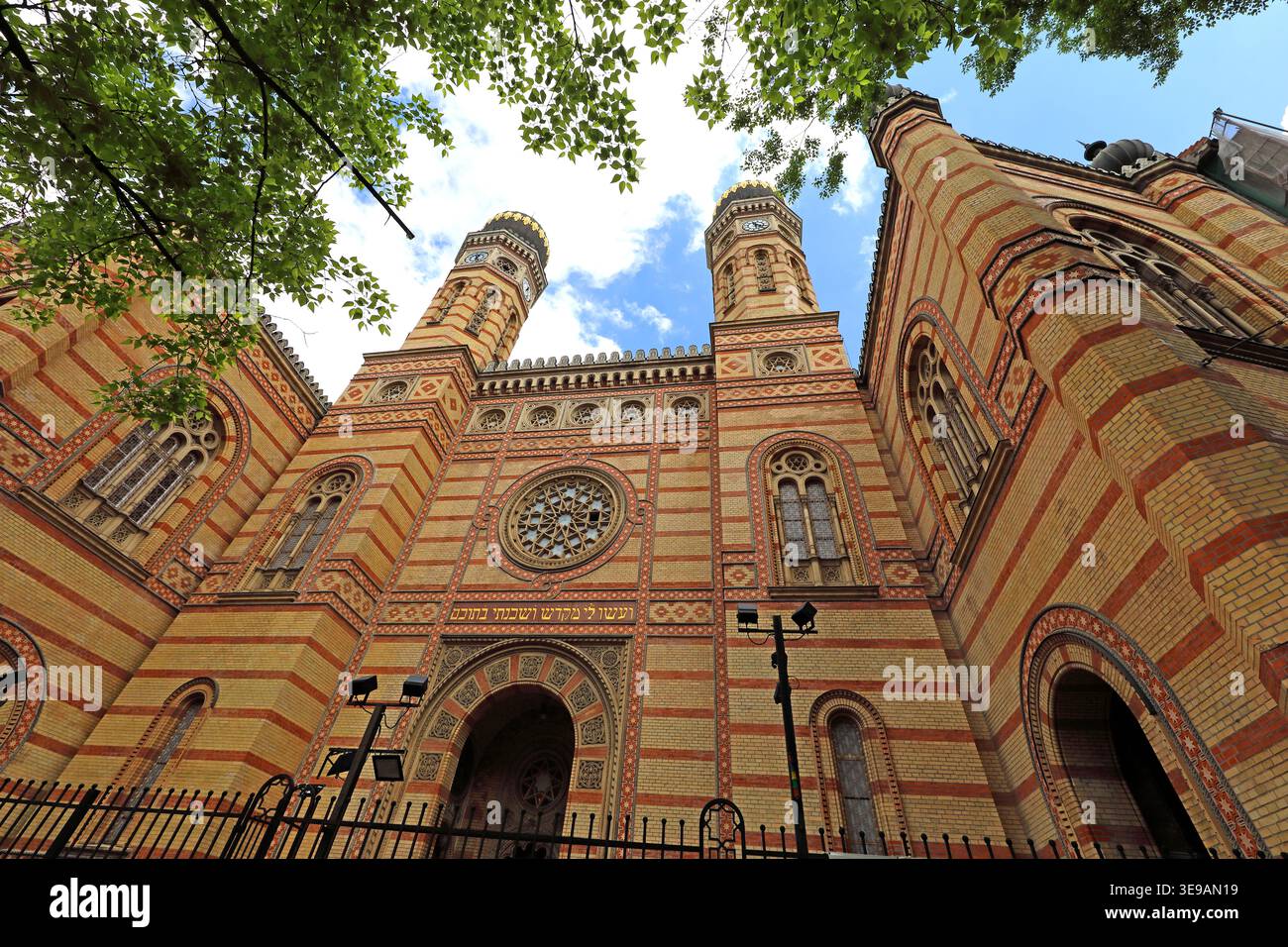
Image details
Contributor:
Tony SmithImage ID:
3E9AN19File size:
86.1 MB (5.2 MB Compressed download)Releases:
Model - no | Property - noDo I need a release?Dimensions:
6720 x 4480 px | 56.9 x 37.9 cm | 22.4 x 14.9 inches | 300dpiDate taken:
30 April 2023Location:
Dohány Street Synagogue, the Great Synagogue of Budapest, with Moorish Revival facade and twin towerMore information:
Low-angle exterior view of Dohány Street Synagogue, also known as the Great Synagogue of Budapest or Nagy Zsinagóga, in the Erzsébetváros district of Budapest, Hungary. The photograph shows the richly patterned Moorish Revival facade, twin towers, arched windows, rose window, decorative brickwork, iron railings and trees framing one of Europe’s most important Jewish religious landmarks. The synagogue was designed by Ludwig Förster and built between 1854 and 1859, with Budapest tourism sources giving its address as Dohány utca 2, 1074 Budapest. Its architecture uses alternating warm brick colours, oriental and Byzantine-inspired decoration and monumental vertical towers, making it visually distinctive among nineteenth-century European synagogues. The site is central to the history of Jewish Budapest and the wider Jewish Quarter, and is closely associated with the Hungarian Jewish Museum, Raoul Wallenberg Memorial Park, Holocaust remembrance, Theodor Herzl’s birthplace area and the long cultural presence of the Pest Jewish community. The image is useful for editorial coverage of Budapest tourism, Jewish heritage, synagogue architecture, religious travel, European history, Holocaust memory, cultural identity, urban landmarks and architectural conservation. It can also support features on Neolog Judaism, Hungarian Jewish life, Central European city breaks, walking tours of the Jewish Quarter, sacred buildings, religious diversity and the relationship between architecture, memory and community survival. The dramatic upward viewpoint emphasises the scale of the facade, while the striped brickwork and arched decorative forms give the image strong visual appeal for travel, history and architecture publishing. Although the building is a major visitor attraction, it remains a religious and cultural site, so the photograph also carries meaning beyond tourism: it represents worship, resilience, remembrance and the continuing visibility of Jewish life in Budapest

