
Historic dock cranes at the Port of Leith, Edinburgh, Scotland, reflecting the harbour's industrial heritage.
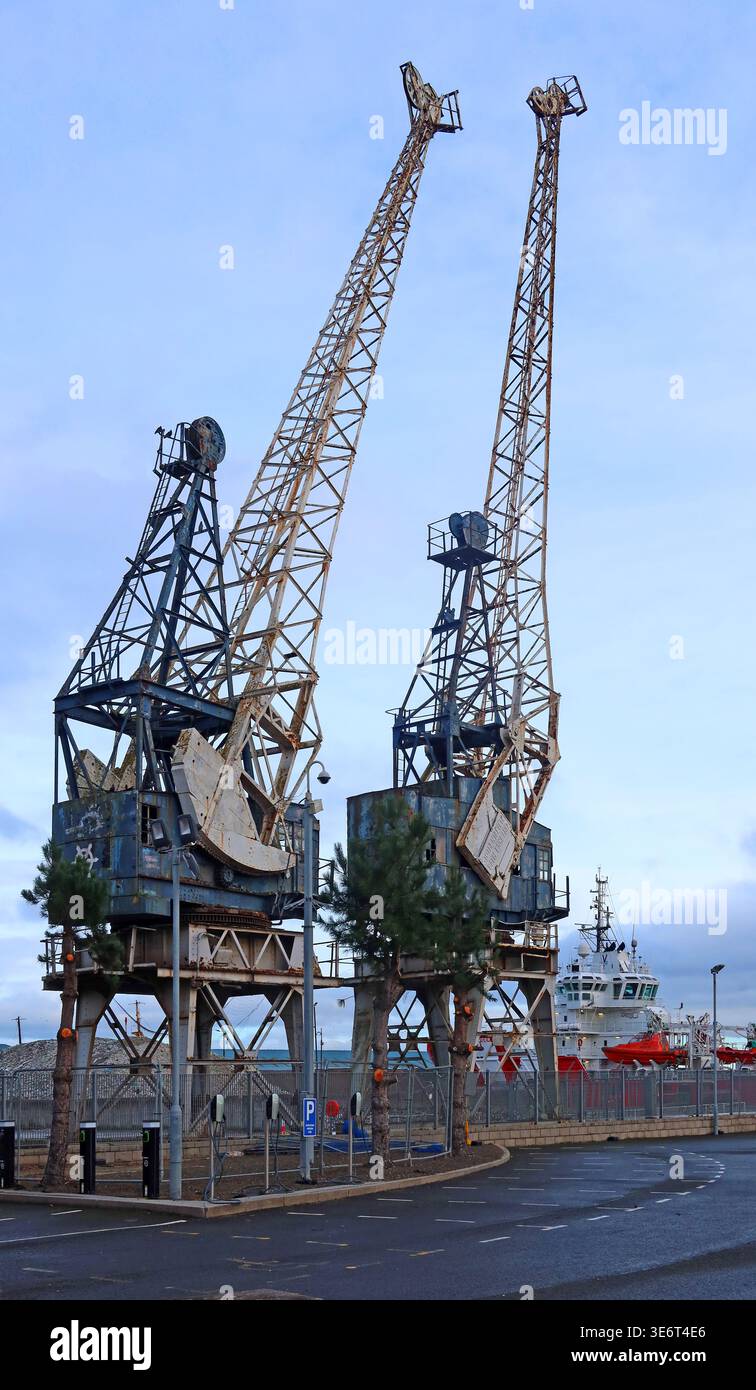
Image details
Contributor:
Tony SmithImage ID:
3E6T4E6File size:
46.4 MB (1.7 MB Compressed download)Releases:
Model - no | Property - noDo I need a release?Dimensions:
3072 x 5280 px | 26 x 44.7 cm | 10.2 x 17.6 inches | 300dpiDate taken:
30 November 2024Location:
Port of Leith, Edinburgh, Scotland, UKMore information:
. A group of tall dock cranes stands at the Port of Leith in Edinburgh, forming a powerful reminder of the harbour’s industrial history and the mechanical equipment once essential to loading and unloading ships. Leith developed over centuries as Edinburgh’s principal maritime gateway, handling imports, exports and coastal trade while supporting shipbuilding, repair, warehousing and dock labour. Large cranes became defining features of twentieth-century port landscapes, transferring cargo between ship holds, quays, sheds, road vehicles and railway wagons. Changes in freight handling, particularly containerisation and specialised bulk systems, dramatically reduced the need for many traditional dockside cranes across Britain. Surviving examples therefore carry an increasing heritage value as physical evidence of labour-intensive port operations and heavy engineering. The cranes at Leith also stand within a waterfront that continues to function commercially under Forth Ports while undergoing major change. Modern activity includes cargo, cruise calls, marine services and substantial investment connected with offshore wind and renewable energy. This juxtaposition of older machinery with a port adapting to new industries illustrates how maritime infrastructure can evolve without completely erasing earlier layers. Leith itself has experienced extensive regeneration and is now closely integrated with Edinburgh’s residential, cultural and tourism economy, yet the docks remain a secure working environment. The photograph concentrates on the angular lattice booms, machinery housings and vertical forms of the cranes against the sky, combining industrial archaeology, Scottish maritime heritage, port engineering and the visual identity of a historic working harbour. The cranes are also reminders of occupational history. Dock work was physically demanding and often organised around gangs responding to the arrival of individual ships.

