
Busy concourse and departure boards inside London Liverpool Street station, a major City of London terminus.
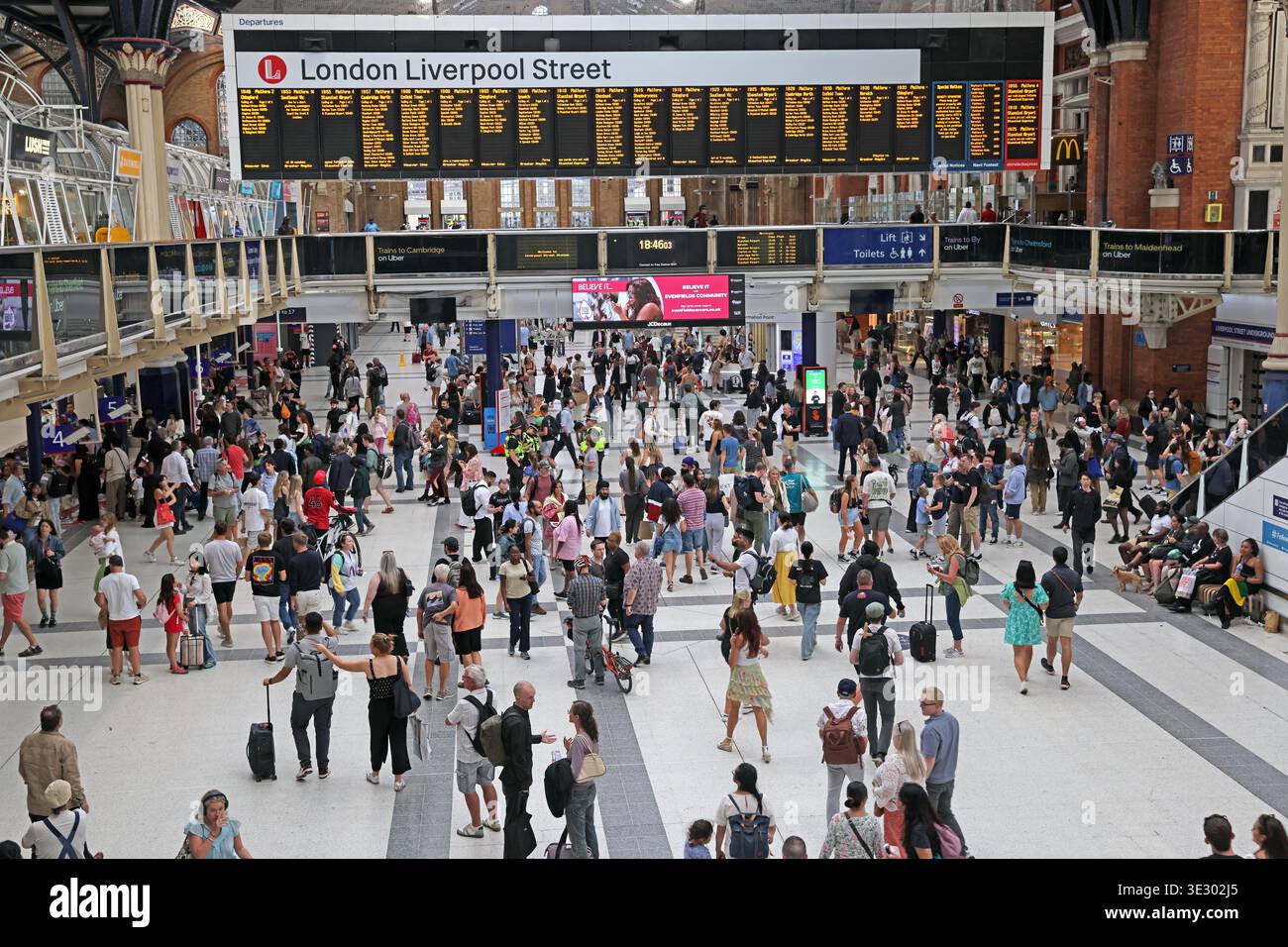
Image details
Contributor:
Tony SmithImage ID:
3E302J5File size:
121.1 MB (5.7 MB Compressed download)Releases:
Model - no | Property - noDo I need a release?Dimensions:
7968 x 5314 px | 67.5 x 45 cm | 26.6 x 17.7 inches | 300dpiDate taken:
24 August 2025Location:
Liverpool Street Station, London EC2M 7PY, England, UKMore information:
. Busy concourse inside London Liverpool Street station, with passengers crossing beneath large electronic departure boards in one of the capital's major railway termini. The first suburban trains used the partially completed station in 1874 and the fully opened terminus followed in 1875 for the Great Eastern Railway. Its location on the edge of the City of London made Liverpool Street a crucial gateway for commuters from north-east London, Essex and East Anglia, a role it continues to perform on a much larger modern network. The station is served by main-line and suburban rail services as well as London Overground and the Elizabeth line, while London Underground connections make the site a major interchange between regional and urban transport. The huge daily flow of office workers reflects Liverpool Street's proximity to the financial district, Broadgate, Bishopsgate and the dense concentration of employment in the City. The image captures the information-intensive character of a modern terminus: departure times, platforms, destinations and service status are continuously displayed above a crowd whose journeys may range from short commutes to inter-city travel. Although the station has been repeatedly rebuilt and expanded, parts of its historic iron-and-glass trainshed and Victorian railway identity remain important elements of the architecture. The original terminus was deliberately set below street level, contrasting with neighbouring Broad Street station, which once stood on a viaduct. Liverpool Street is also closely linked to the history of migration and wartime memory, notably through the Kindertransport memorials associated with Jewish refugee children arriving in Britain before the Second World War. Recent redevelopment around the station has brought new offices, retail space and the Elizabeth line while also prompting debate about how major transport hubs should balance capacity, commercial development and heritage.

