
Historic Sale Town Hall and First World War memorial on School Road, Sale, Greater Manchester,a landmark municipal building reflecting civic pride
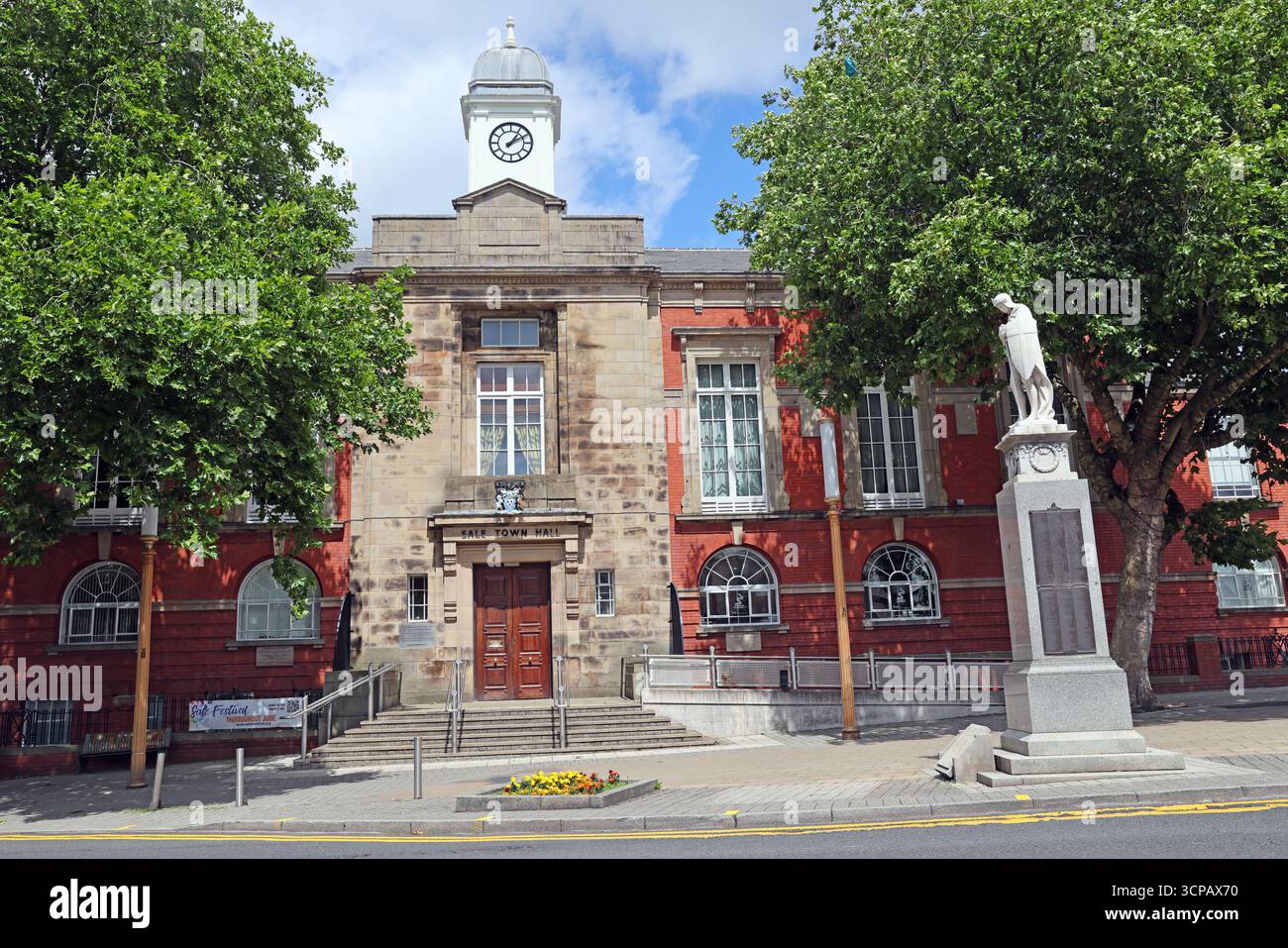
Image details
Contributor:
Tony SmithImage ID:
3CPAX70File size:
115.8 MB (6.7 MB Compressed download)Releases:
Model - no | Property - noDo I need a release?Dimensions:
7791 x 5197 px | 66 x 44 cm | 26 x 17.3 inches | 300dpiDate taken:
28 June 2025Location:
Sale Town Hall, School Road, Sale, Trafford, Greater Manchester, M33 7ZFMore information:
Sale Town Hall is one of Trafford’s most recognisable civic landmarks, standing prominently on School Road in the heart of Sale, Greater Manchester. Constructed in phases between 1914 and 1940 in an elegant Neoclassical style, it originally served as the headquarters of Sale Urban District Council before becoming the seat of Sale Borough Council. The building reflects the confidence of a rapidly expanding commuter town during the early twentieth century, when prosperous suburbs invested heavily in impressive public architecture to express civic identity and municipal ambition. The town hall suffered significant bomb damage during the Manchester Blitz in December 1940 before being restored, with its distinctive clock tower and cupola completed in 1952. Facing the building is the town’s First World War memorial, creating an important civic ensemble that continues to define Sale’s historic centre. Since local government reorganisation in 1974 transferred civic administration to Trafford Council, buildings such as Sale Town Hall have increasingly evolved beyond their original administrative purpose. Across Britain, historic town halls represent valuable public assets that can become catalysts for regeneration rather than simply monuments to former local government. Sensitive adaptation can introduce flexible co-working offices, start-up business incubators, libraries, maker spaces, digital innovation centres, exhibition galleries, performance venues, cafés, wedding facilities, community health services, higher education outreach centres and evening cultural programmes while retaining important council chambers and historic interiors. Such mixed-use approaches can increase daily footfall, strengthen local high streets, preserve architectural heritage and provide sustainable long-term income, ensuring landmark civic buildings remain active parts of their communities instead of underused heritage liabilities. For suburban centres such as Sale, imaginative reuse of historic

