
Drawing frames (sometimes called draw frames) with sliver cans, as used in Lancashire cotton spinning mills
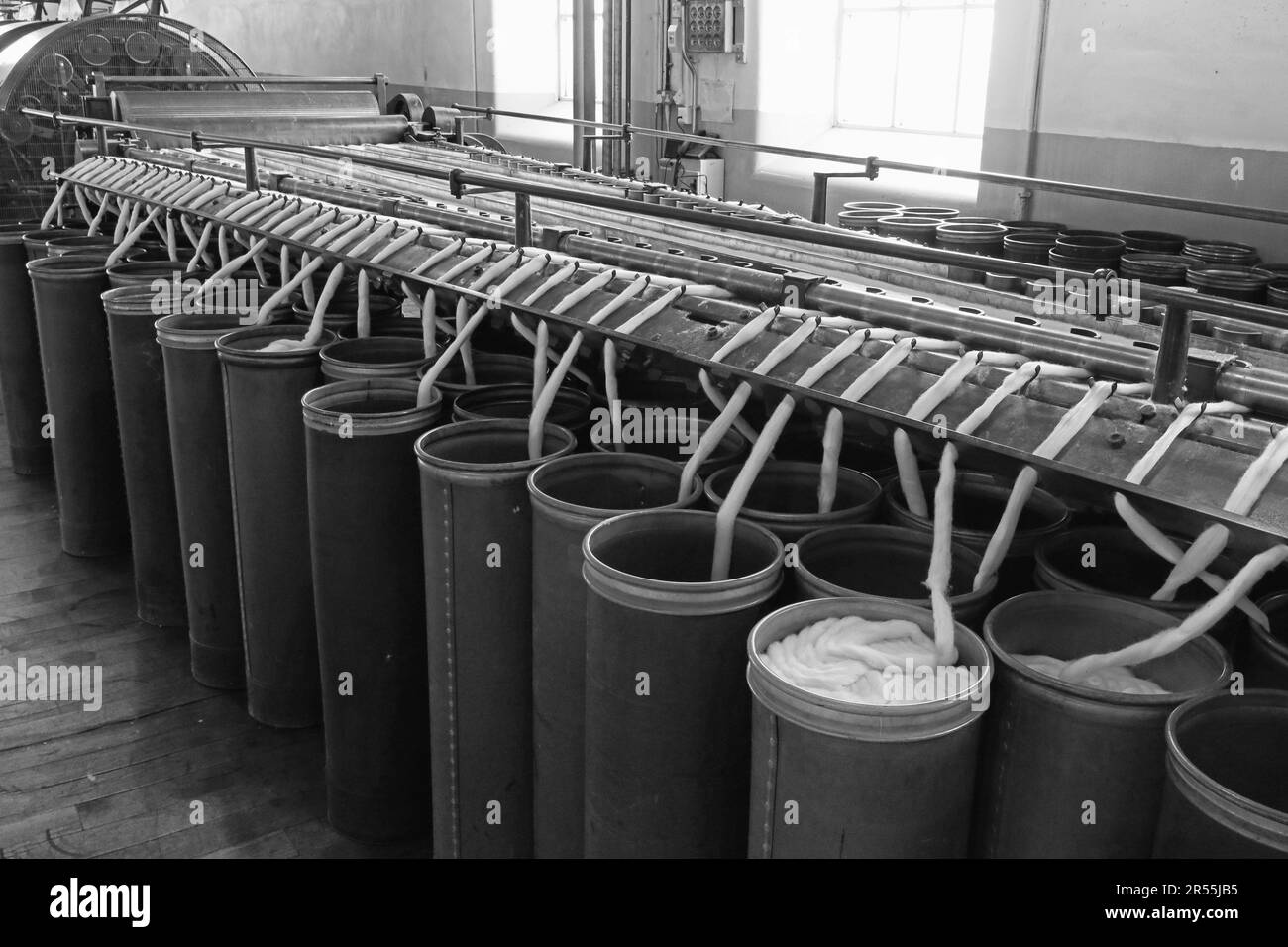
Image details
Contributor:
Tony SmithImage ID:
2R55JB5File size:
57.1 MB (1.9 MB Compressed download)Releases:
Model - no | Property - noDo I need a release?Dimensions:
5472 x 3648 px | 46.3 x 30.9 cm | 18.2 x 12.2 inches | 300dpiDate taken:
26 May 2023Location:
Lancashire, England, UKMore information:
drawing frames (sometimes called draw frames) with sliver cans, as used in Lancashire cotton spinning mills in the late-19th and early-20th century. What you’re seeing The thick, soft cotton strands looping down into the containers are sliver. The tall cylindrical containers are sliver cans, used to store and transport the fibre between processes. Above the cans is the drawing frame, with a line of drafting rollers that pull multiple slivers together and stretch them to improve uniformity. What the drawing frame did The drawing frame sat between carding and spinning and had three main jobs: Combine several carded slivers into one Draft (stretch) the fibres to make them finer Straighten and equalise fibre alignment The output was a smoother, more even sliver ready for: further drawing stages, or the roving (speed) frame, and then spinning How to tell it’s not a roving frame This is a common point of confusion: Drawing frame: sliver goes into cans (as shown here) Roving (speed) frame: fibres are twisted and wound onto bobbin spindles, not cans Because there is no twist and the material is collected loosely in cans, this is clearly a drawing frame. Why this is classic Lancashire Drawing frames were standard in mills across Oldham, Bolton, Blackburn, Burnley and Preston Lancashire mills often used multiple drawing passages to achieve consistency at scale Uniform sliver was essential for high-speed spinning on mules or ring frames In short This image shows cotton drawing frames feeding sliver into cans, a crucial intermediate stage in Lancashire’s spinning process, responsible for fibre consistency, quality and productivity. This image shows a row of cotton drawing frames with sliver cans inside a Lancashire spinning mill, illustrating a key intermediate stage in the cotton manufacturing process. Drawing frames were used after carding to improve the uniformity, alignment and consistency of cotton fibres before they were spun into yarn.

