
Cotton ring spinning frame inside a Lancashire spinning mill, showing rows of spindles twisting and winding yarn during industrial textile production.
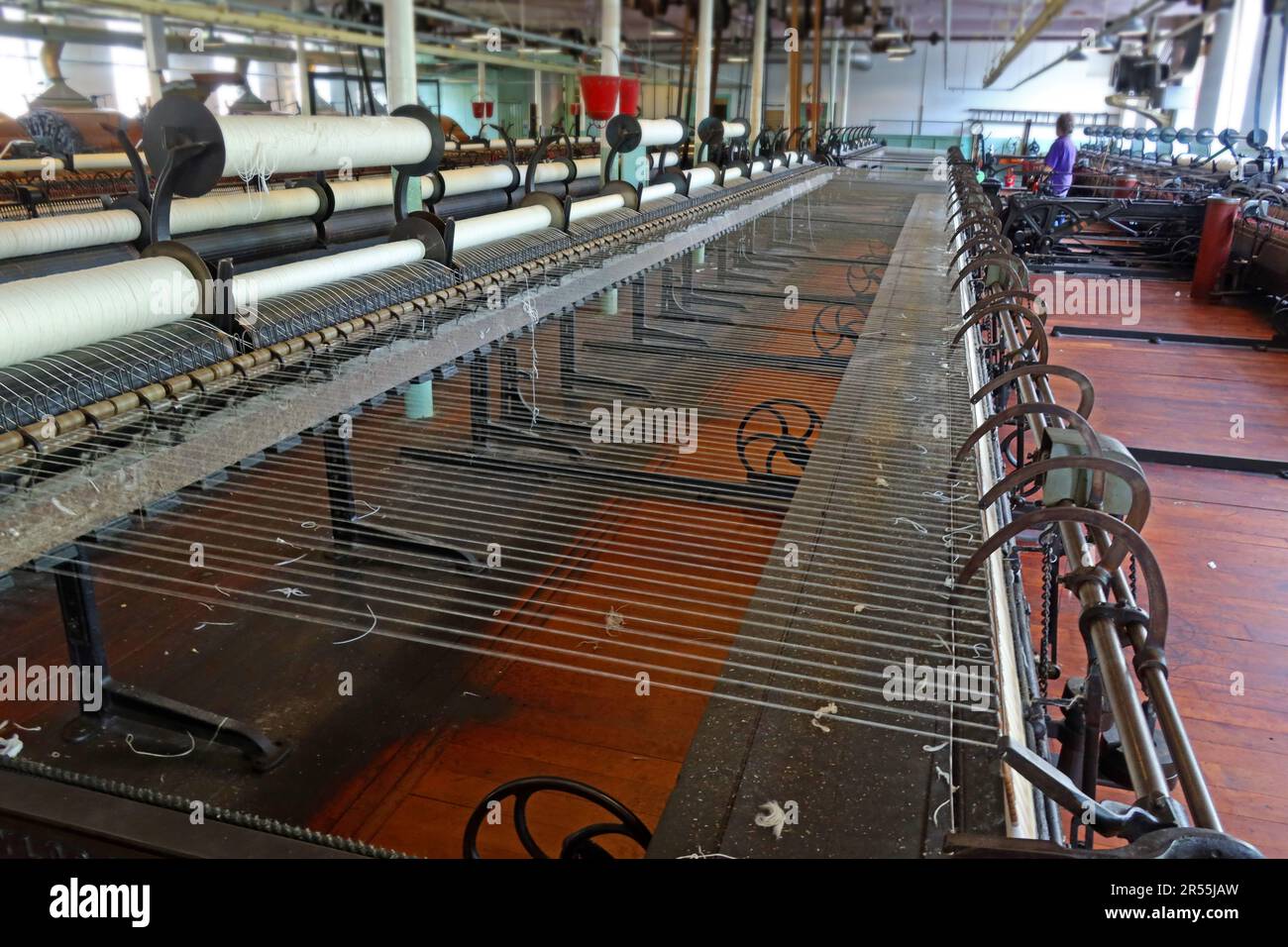
Image details
Contributor:
Tony SmithImage ID:
2R55JAWFile size:
57.1 MB (2 MB Compressed download)Releases:
Model - no | Property - noDo I need a release?Dimensions:
5472 x 3648 px | 46.3 x 30.9 cm | 18.2 x 12.2 inches | 300dpiDate taken:
26 May 2023Location:
Lancashire, England, UKMore information:
This machine is a cotton ring spinning frame (often shortened to ring frame), as widely used in Lancashire spinning mills from the early 20th century onwards. How we know: Long rows of parallel yarn threads running vertically down to spindles Ring and traveller system at each spindle position Yarn being twisted and wound simultaneously onto bobbins Linear, repetitive layout typical of ring spinning rooms This is not a spinning mule (no moving carriage) and not a drawing or roving frame (those do not insert final twist). Ring frames became dominant in Lancashire for their continuous operation, higher speeds, and suitability for finer yarns. cotton ring spinning frame inside a Lancashire spinning mill, representing one of the most important technological advances in industrial textile production. Ring spinning frames were used to twist and wind cotton fibres into finished yarn in a continuous process, replacing earlier spinning mule systems in many mills during the twentieth century. Prepared roving from earlier processes such as carding and drawing was fed into the frame, where drafting rollers reduced the fibre thickness before twist was inserted by the rotating spindle and traveller running around a fixed ring. The finished yarn was then wound onto bobbins, ready for use in weaving sheds or for further processing. Ring spinning offered higher speeds, greater consistency and reduced labour compared with mule spinning, making it especially suited to fine and strong yarns. Lancashire mills adopted ring frames widely as the industry modernised, particularly in large spinning towns such as Oldham and Bolton. Preserved ring spinning frames are now commonly found in textile museums and heritage mills, illustrating the scale, precision and repetitive nature of industrial cotton production and the working environments that underpinned Britain’s global dominance in textiles.

