
The Flying Scouseman Pendolino train, at Warrington Bank Quay, Cheshire, England, UK, WA1 named by Echo reader Michael Dally, of Runcorn
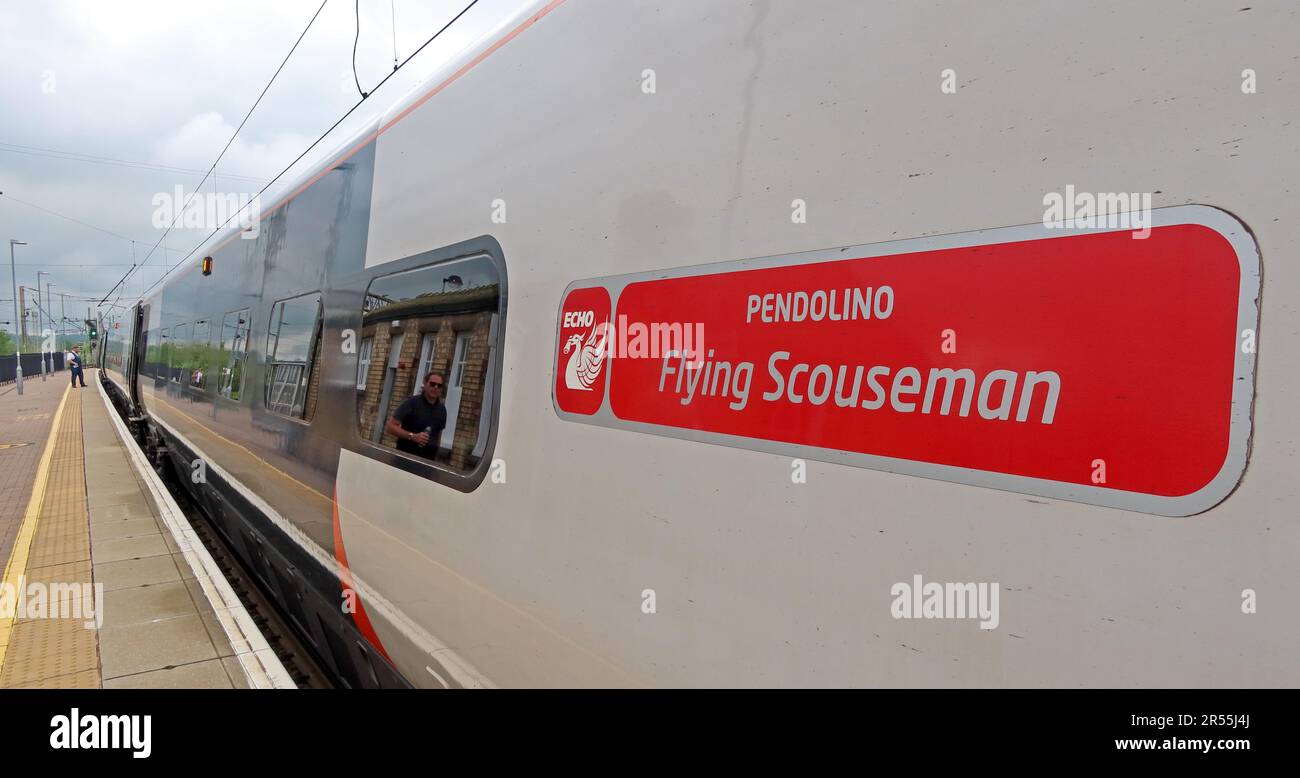
Image details
Contributor:
Tony SmithImage ID:
2R55J4JFile size:
41.1 MB (926.5 KB Compressed download)Releases:
Model - no | Property - noDo I need a release?Dimensions:
5208 x 2760 px | 44.1 x 23.4 cm | 17.4 x 9.2 inches | 300dpiDate taken:
19 May 2023Location:
Warrington Bank Quay, Cheshire, England, UK, WA1More information:
. The Flying Scouseman Pendolino train, at Warrington Bank Quay, Cheshire, England, UK, WA1 named by Echo reader Michael Dally, of Runcorn. Photographed on 19 May 2023. Virgin Trains Pendolino given Flying Scouseman name to mark firm's 20th birthday. ECHO competition won by Michael Dally, of Runcorn. Read more at ECHO teamed up with Virgin Trains to help celebrate the firm's 20th birthday and invited people to come up with a name for one of their iconic Pendolinos, used on the West Coast mainline between Lime Street and Euston. Other shortlisted suggestions for the new name included Mighty Mersey, Pride of Liverpool, Merseyside Express and Liver Bird. Arif Mahmood, Virgin Trains station manager for Liverpool Lime Street said the response to the competition had been overwhelming. Euston was London's first inter-city railway terminus, opening in 1837 as the southern end of the London and Birmingham Railway. The famous Doric Euston Arch and Victorian station were demolished during the controversial 1960s rebuilding. In 2026 Euston remains central to plans for HS2 and wider station redevelopment. In relation to station architecture, historical context shows that stations are both functional transport interchanges and pieces of civic architecture; Their canopies, footbridges, booking halls, signal boxes and signage reveal how passenger expectations and railway technology changed from steam-era operation to today's increasingly digital network. For the story of payment methods, it is useful to note that banknotes, coins, cheques and branch buildings document the everyday financial system before contactless cards and mobile payments became dominant; Regional banks and savings institutions also left distinctive architecture and branded paper evidence. The historical setting for coastal economy is that maritime gateways connect island and mainland economies, carrying residents, visitors, freight and vehicles while also supporting fishing, leisure craft and.

