
Lancashire cotton loom shuttle, that carries yarn back and forth through the warp in order to create cloth, Burnley, England, UK
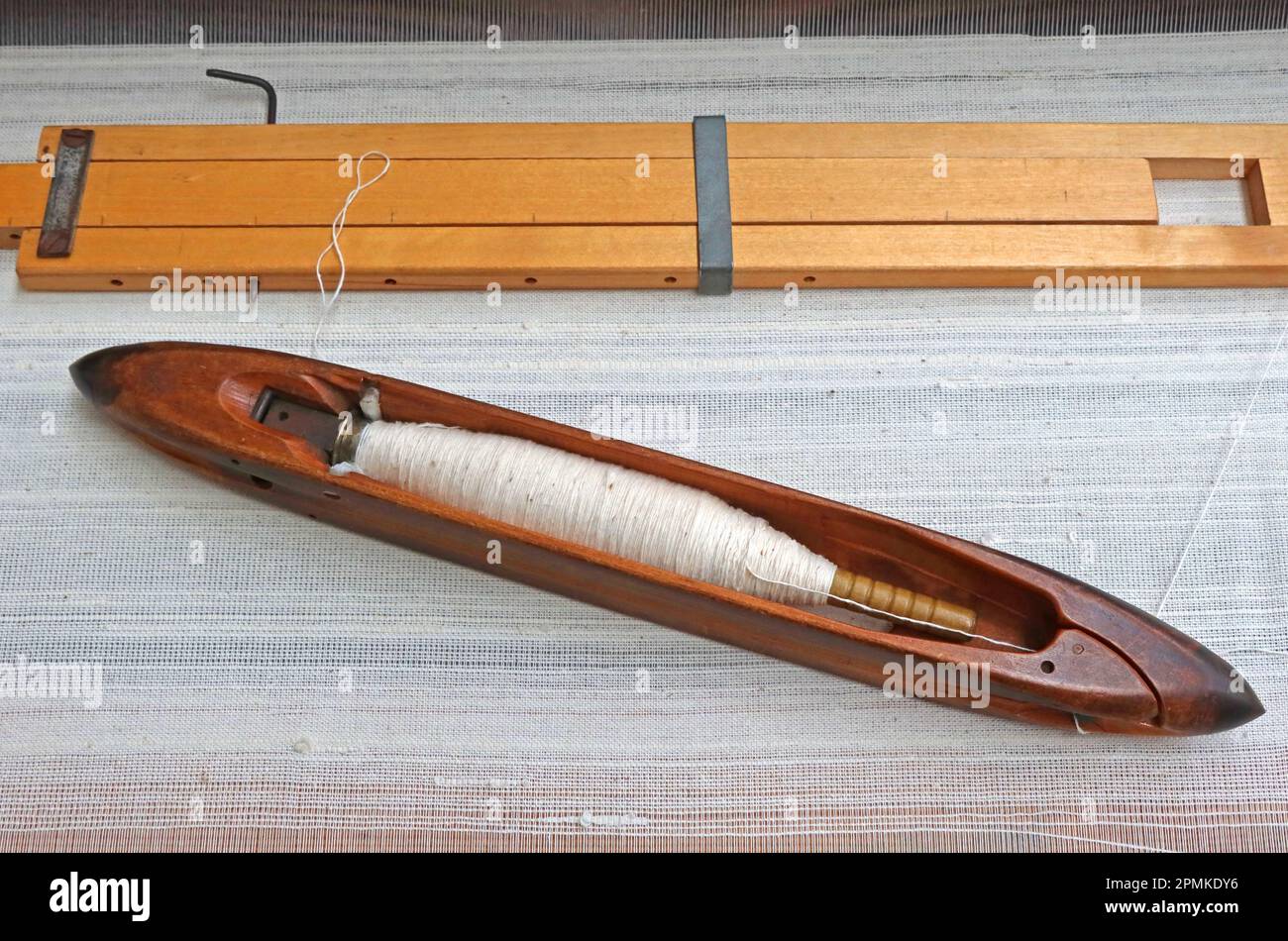
Image details
Contributor:
Tony SmithImage ID:
2PMKDY6File size:
51.6 MB (2.8 MB Compressed download)Releases:
Model - no | Property - noDo I need a release?Dimensions:
5220 x 3456 px | 44.2 x 29.3 cm | 17.4 x 11.5 inches | 300dpiDate taken:
6 April 2023Location:
Queen Street Mill, Harle Syke, Briercliffe, Burnley BB10 2HXMore information:
A shuttle is a tool designed to neatly and compactly store a holder that carries the thread of the weft yarn while weaving with a loom. Shuttles are thrown or passed back and forth through the shed, between the yarn threads of the warp in order to weave in the weft. The simplest shuttles, known as "stick shuttles", are made from a flat, narrow piece of wood with notches on the ends to hold the weft yarn. More complicated shuttles incorporate bobbins or pirns. In the United States, shuttles are often made of wood from the flowering dogwood, because it is hard, resists splintering, and can be polished to a very smooth finish. In the United Kingdom shuttles were usually made of boxwood, cornel, or persimmon. Flying shuttle Shuttles were originally passed back and forth by hand. However, John Kay invented a loom in 1733 that incorporated a flying shuttle. This shuttle could be thrown through the warp, which allowed much wider cloth to be woven much more quickly and made the development of machine looms much simpler. Though air-jet and water-jet looms are common in large operations, many companies still use flying shuttle looms. This is due in large part to their being easier to maintain than the more modern looms. In modern flying shuttle looms, the shuttle itself is made of rounded steel, with a hook in the back which carries the filler, or "pick."

