
“Looking to a Better Future” mural in East Belfast promotes peace,understanding,equality,diversity & reconciliation after conflict, Northern Ireland
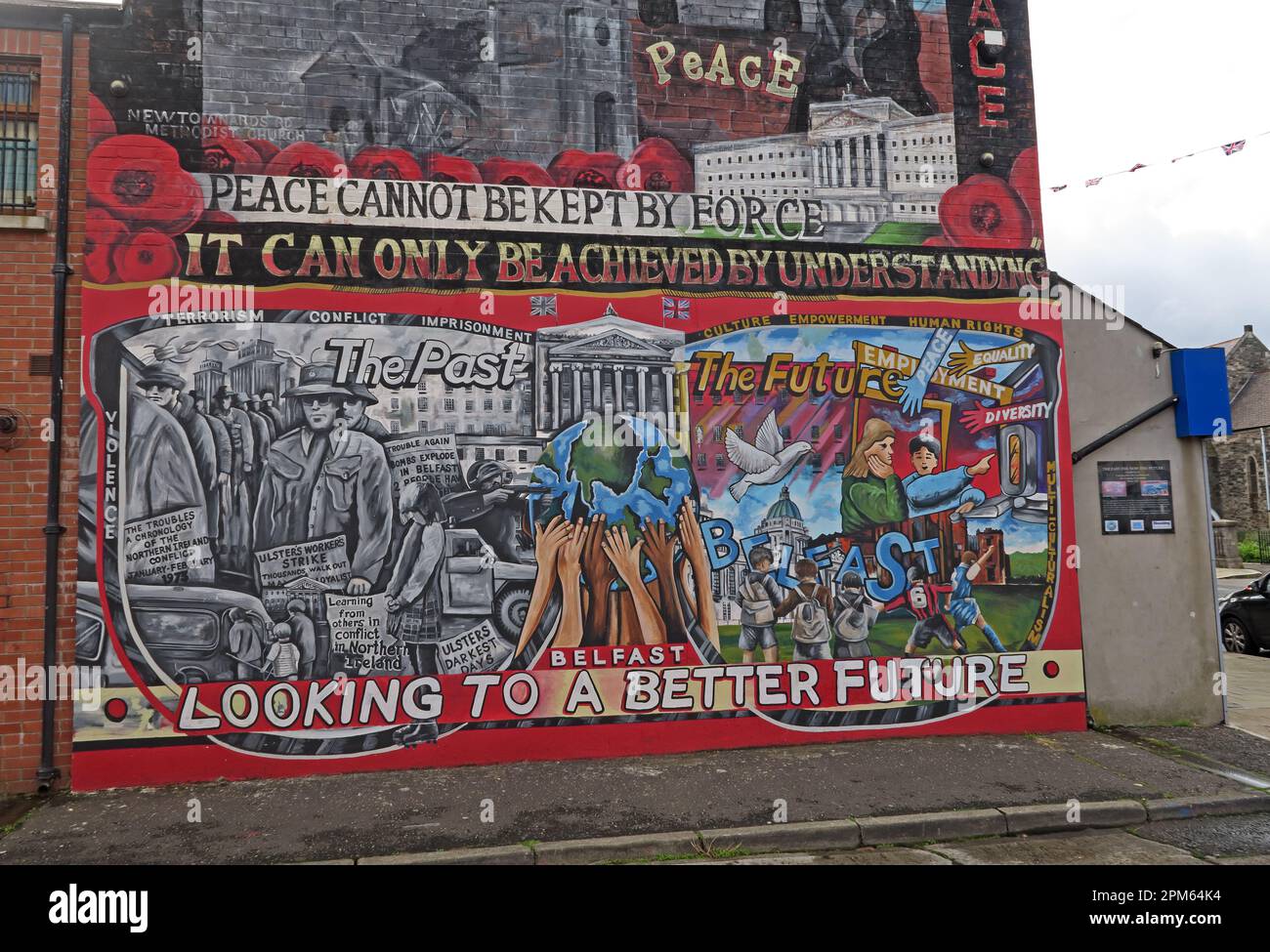
Image details
Contributor:
Tony SmithImage ID:
2PM64K4File size:
50.8 MB (2.5 MB Compressed download)Releases:
Model - no | Property - noDo I need a release?Dimensions:
5102 x 3477 px | 43.2 x 29.4 cm | 17 x 11.6 inches | 300dpiDate taken:
19 August 2017Location:
211 Newtownards Rd, Belfast , Northern Ireland, UK, BT4 1EAMore information:
Community peace mural on Newtownards Road in East Belfast, Northern Ireland, contrasting memories of the Troubles with an explicitly optimistic vision of a more peaceful and inclusive city. Across the top, the mural carries the message “Peace cannot be kept by force, it can only be achieved by understanding”, set among remembrance poppies and Belfast civic imagery. Below, the large “Looking to a Better Future” panel divides the composition into “The Past” and “The Future”. The monochrome past section depicts imprisonment, security infrastructure, street conflict, vehicles, political tension and references to terrorism and violence, evoking the atmosphere of Belfast during decades of sectarian conflict. The future section is deliberately brighter and more colourful, showing raised hands around a globe, Belfast City Hall, children, sport, education and computer technology. Words such as culture, empowerment, equality, diversity, multiculturalism and human rights identify the values being promoted. The lower mural dates from around 2013 and was associated with a community regeneration project involving organisations including Belfast City Council, Charter NI and the Northern Ireland Housing Executive. Its design reflects a wider post-conflict movement in Belfast in which some traditional political mural sites were repainted to emphasise reconciliation, community development and shared aspirations while still acknowledging the city's difficult recent history. The work is especially notable for placing the legacy of violence and division directly beside images of opportunity, participation and civic life. It also records the continuing importance of large-scale gable-end murals to Belfast's visual identity, where walls have long been used to communicate political allegiance, historical memory, social change and changing community priorities. The contrast turns the wall into statement about moving from division towards coexistence, opportunity and confidence.

