
Sir William Temple bronze embossed sculpture, outside The Temple Bar pub, 47-48 Temple Bar, Dublin 2, D02 N725, Ireland
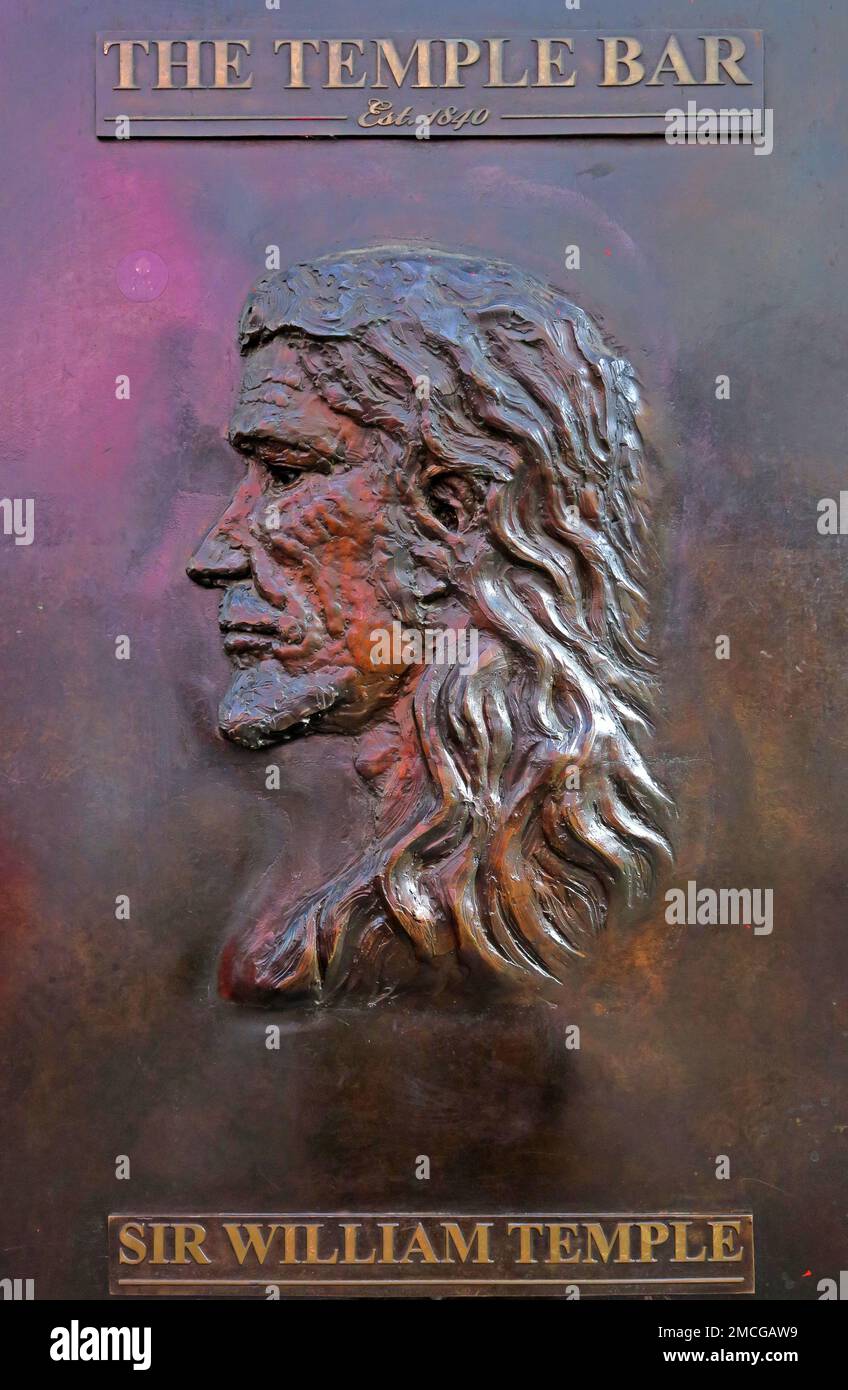
Image details
Contributor:
Tony SmithImage ID:
2MCGAW9File size:
44.5 MB (2.2 MB Compressed download)Releases:
Model - no | Property - noDo I need a release?Dimensions:
3184 x 4880 px | 27 x 41.3 cm | 10.6 x 16.3 inches | 300dpiDate taken:
11 September 2019Location:
47-48 Temple Bar, Dublin 2, D02 N725, IrelandMore information:
William Temple was born the son of the Leicestershire man Anthony Temple, whose family name was said to descend from the Knight Templars, a once powerful monastic order during the Crusades, but which was outlawed by Pope Clement V. The rituals and the secrets of the order survived and many of the Knight Templars families came to prominence in 16th-century England when Protestantism was embraced. He was educated at Eton College and passed with a scholarship to King's College, Cambridge, in 1573. In 1576 he was elected a fellow of King's, and graduated with a B.A. in 1577–8 and M.A. in philosophy in 1581. He became Master of Lincoln Grammar School that same year. Though originally destined for the law, he became a tutor in logic at his college. "In his logic readings, " wrote a pupil, Anthony Wotton, in his Runne from Rome (1624), "he always laboured to fit his pupils for the true use of that art rather than for vain and idle speculations." He accepted with enthusiasm the logical methods and views of Petrus Ramus, and became the most active champion of the Ramists in England. William Temple's first sight of Ireland came as he landed at Howth in April 1599 to take up his position as secretary to the new lord lieutenant, Robert Devereux, and 2nd Earl of Essex. It was a baptism of fire as their first great task was to suppress a major rebellion of the native Irish tribes who had now united with the Anglo-Normans. While Essex campaigned around the country, Temple stayed behind in Dublin that summer relaying news of military deployment and successes to the Royal Court, Essex, once Elizabeth's most trusted confidant and intimate advisor, now became the unappreciated and maligned viceroy falling foul of the ageing queen. Both he and William Temple were ignominiously recalled to London that same autumn.

