
William MacKenzie's Pyramid shaped Tomb, St Andrew's Church, Rodney Street, Liverpool, Merseyside, England, UK, L1 2TQ
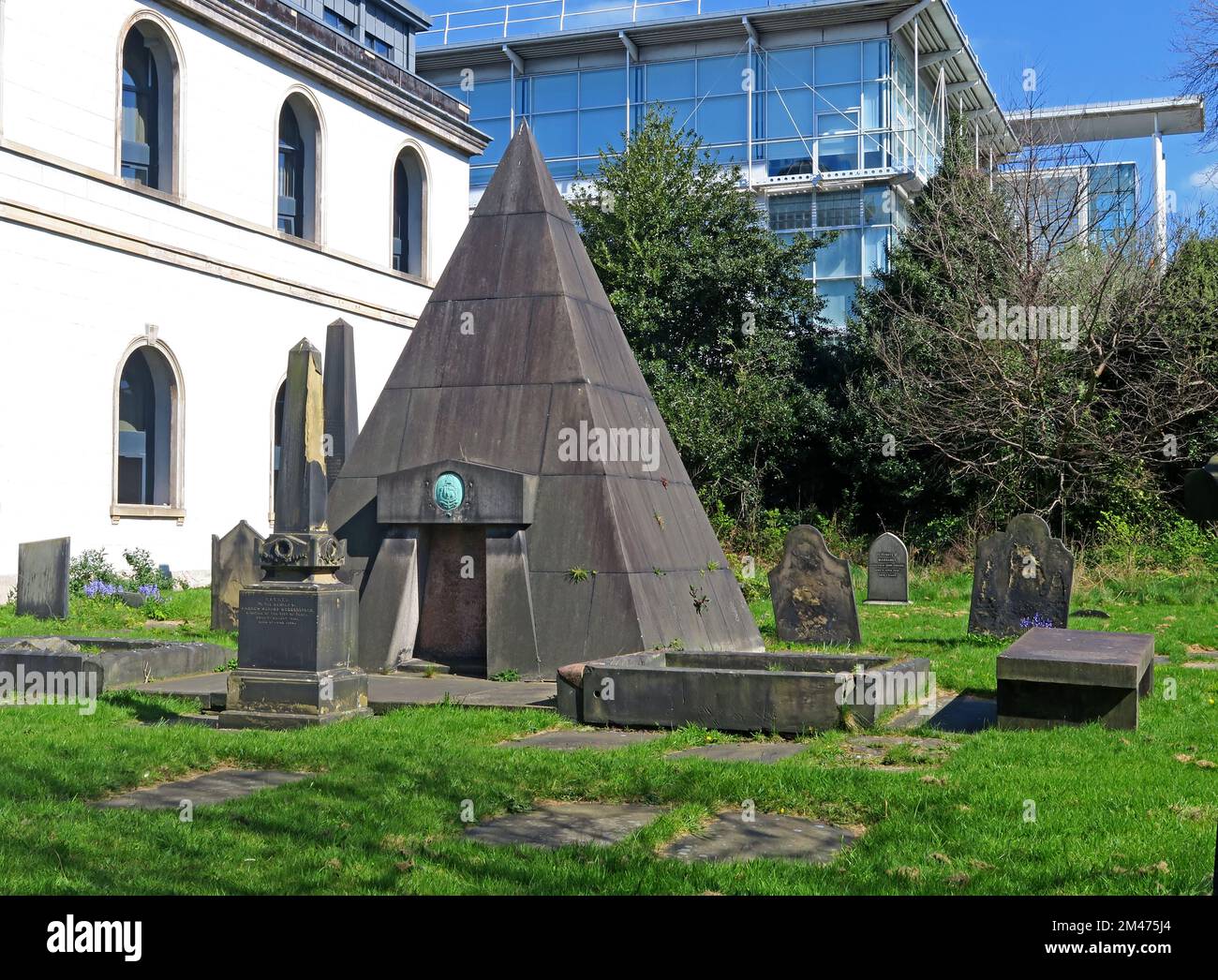
Image details
Contributor:
Tony SmithImage ID:
2M475J4File size:
47.8 MB (2.9 MB Compressed download)Releases:
Model - no | Property - noDo I need a release?Dimensions:
4764 x 3504 px | 40.3 x 29.7 cm | 15.9 x 11.7 inches | 300dpiDate taken:
11 April 2019Location:
St Andrew's Church, Rodney Street, Liverpool, Merseyside, England, UK, L1 2TQMore information:
William Mackenzie (20 March 1794 – 29 October 1851) was an Anglo-Scottish civil engineer and civil engineering contractor who was one of the leading European contractors in the 1840s his profitable contracts including tunnels on the Liverpool and Manchester Railway between Edge Hill and Lime Street, and contracts for the Grand Union, North Union, Midland Counties and Glasgow, Paisley and Greenock railways. Non-railway contracts included Liverpool Haymarket, the Manchester and Sheffield Junction Canal and the Shannon navigation In 1819 Mackenzie married Mary Dalziel, daughter of a Glasgow commission agent. Mary died in 1838 and in 1839 he married Sarah Dewhurst. Mackenzie maintained offices in Paris and in Liverpool and from 1843 he lived at 74 Grove Street, Liverpool, where he died in 1851. He was buried in St Andrew's Church, Rodney Street, Liverpool in 1851. A pyramid-shaped monument was erected at the grave by his brother Edward in 1868. An inscription on the pyramid door reads: "In the vault beneath lie the remains of William Mackenzie of Newbie, Dumfriesshire, Esquire who died 29th October 1851 aged 57 years. Also, Mary his wife, who died 19th December 1838 aged 48 years and Sarah, his second wife who died 9th December 1867 aged 60 years. This monument was erected by his Brother Edward as a token of love and affection A.D. 1868. The memory of the just is blessed". William's estate amounted to £341, 848, almost all of which was left to his youngest brother, Edward. He had no children. The Diary of William Mackenzie, published by Thomas Telford Publishing in 2000, is a full transcription of Mackenzie's handwritten diaries, and it provides insight into his busy life. The inscription proves that MacKenzie was buried beneath (not entombed inside) the pyramid and that the monument itself was not erected until 16 years after his demise. Even so, the legend of his upright interment continues to be told and believed by many.

