
Saddam Hussein & Uday Saddam Husayn, ace of spades playing cards, issued by USA, during coalition war in Iraq, 2003 invasion,Iraqi Most Wanted
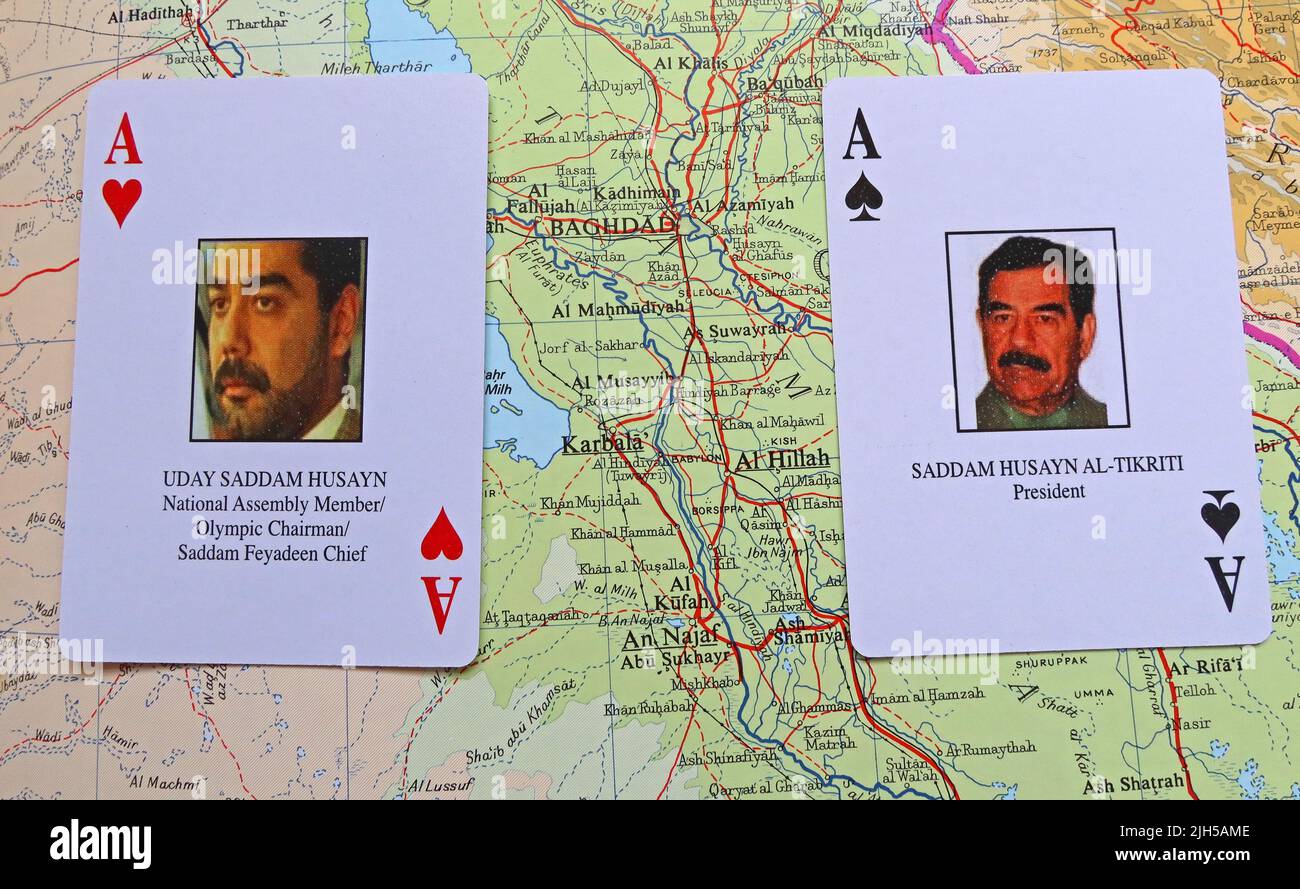
Image details
Contributor:
Tony SmithImage ID:
2JH5AMEFile size:
46 MB (2.2 MB Compressed download)Releases:
Model - no | Property - noDo I need a release?Dimensions:
5112 x 3144 px | 43.3 x 26.6 cm | 17 x 10.5 inches | 300dpiDate taken:
15 July 2022Location:
Baghdad, IraqMore information:
2003 Iraqi Most Wanted playing cards laid on a detailed printed map of Iraq, with Baghdad, Karbala, Al Hillah and nearby road and place names visible. The right-hand card shows Saddam Hussein Abd al-Majid al-Tikriti, president of Iraq, as the ace of spades. The left-hand card shows Uday Saddam Husayn, listed as National Assembly Member, Olympic Chairman and Saddam Fedayeen Chief, as the ace of hearts. The image provides a direct visual link between military intelligence, battlefield recognition, the United States-led coalition invasion of Iraq in 2003, and the wider search for senior figures from Saddam Hussein’s regime. The cards were part of the now widely recognised Iraq Most Wanted deck, a practical identification aid used by coalition personnel and later a powerful symbol of Operation Iraqi Freedom, regime collapse, occupation, contested intelligence and the political aftermath of the war. Set against the map, the playing cards become more than simple military ephemera: they work as a compact documentary image about war planning, geography, propaganda, leadership targeting, dictatorship, Ba'ath Party power structures, and the way conflict turns names, faces and places into public symbols. The clean studio composition and readable card text make it useful for newspapers, magazines, books, educational material, museum displays and online features exploring the Iraq War, the fall of Saddam Hussein, the role of Uday Hussein, US and British military involvement, postwar instability, Middle East geopolitics, high-value target lists, military collectibles and the long legacy of the 2003 invasion. The warm map colours, road markings and city labels add geographic context, while the two aces give the photograph a strong graphic quality suited to stories about power, pursuit, intelligence, memory and the transformation of recent war into archive history.

