
Citizen watch company, automatic 21 Jewels watch, Japan made, in Nishitokyo, Tokyo
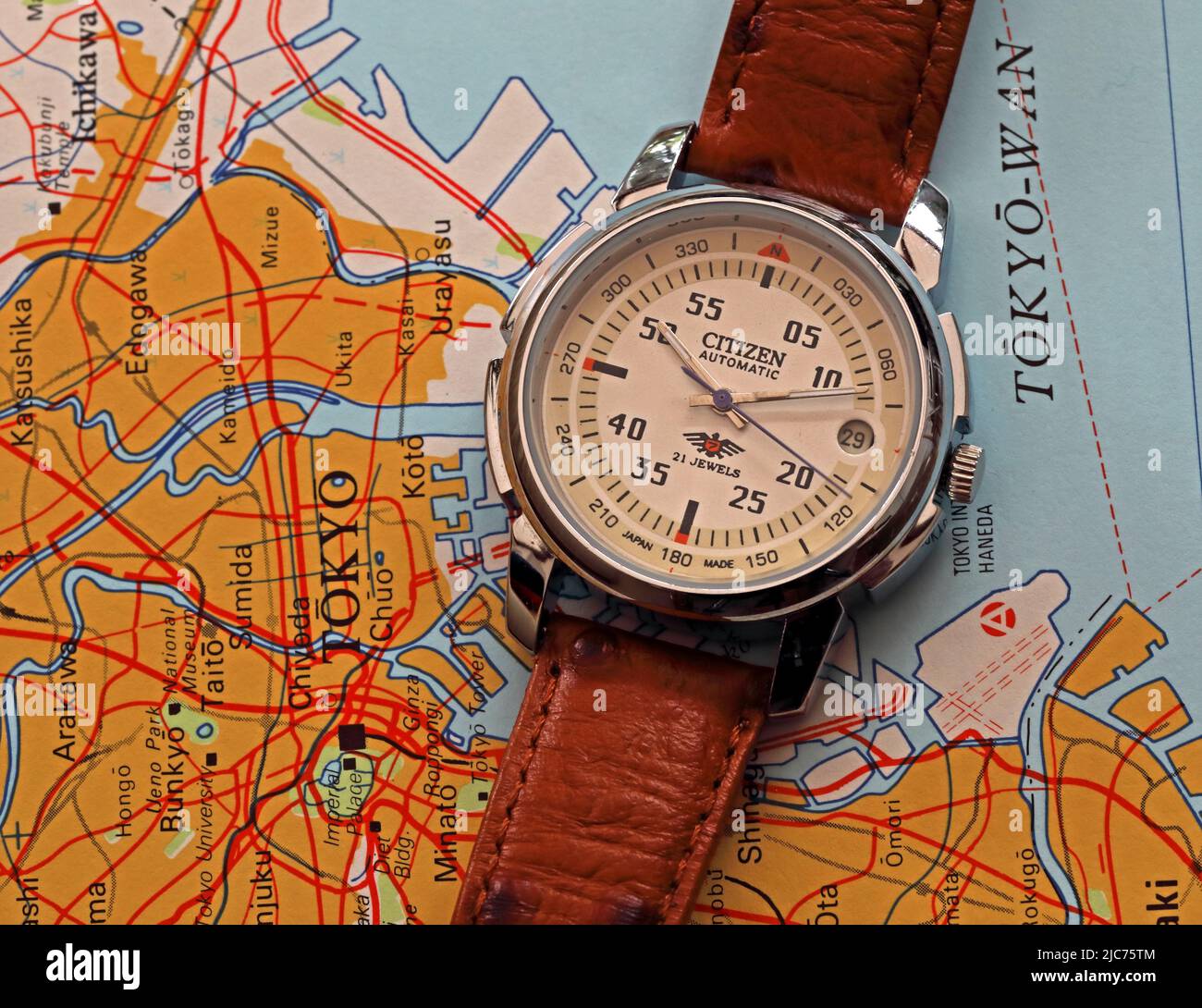
Image details
Contributor:
Tony SmithImage ID:
2JC75TMFile size:
55.6 MB (2.2 MB Compressed download)Releases:
Model - no | Property - noDo I need a release?Dimensions:
5028 x 3868 px | 42.6 x 32.7 cm | 16.8 x 12.9 inches | 300dpiDate taken:
7 April 2022Location:
6 Chome-10-1 Ginza, Chuo City, Tokyo 104-0061, JapanMore information:
Citizen automatic mechanical wristwatch with a cream-coloured dial, polished silver-tone case and brown leather strap is photographed on a detailed street and railway map of Tokyo, Japan. The dial is marked “CITIZEN AUTOMATIC” and “21 JEWELS”, with Arabic numerals, applied hour markers, luminous hands, central seconds hand, minute scale and a date aperture showing 29. The map beneath the watch includes Tokyo Bay, urban districts, waterways, roads, railway lines and Japanese place names, linking the timepiece visually with the country and city associated with its manufacturer. Citizen Watch Co., Ltd. is a Japanese watch and electronics business headquartered at 6-1-12 Tanashi-cho, Nishi-Tokyo-shi, Tokyo. Its origins lie in the Shokosha Watch Research Institute, established in 1918 with the ambition of producing Japanese-made timepieces. The institute completed its first pocket watch in 1924, while Citizen Watch Co., Ltd. was formally established in 1930 and produced its first wristwatch in 1931. The Citizen name expressed the hope that watches would become familiar and affordable products for ordinary citizens. This watch represents the long-established mechanical side of Citizen production, before and alongside the company’s later expansion into electronic, quartz and light-powered technologies. Its self-winding movement uses motion from the wearer’s wrist to wind the mainspring, while jewel bearings reduce friction within the mechanism. The “21 jewels” inscription is therefore a functional description of the movement rather than decorative wording. The still-life composition is relevant to Japanese watchmaking, horology, precision engineering, collecting, consumer design, manufacturing heritage and the international watch trade. The Tokyo map adds themes of place, origin, travel and global business, while the worn brown strap gives the watch the appearance of a practical everyday object rather than an unused showroom product.

