
2018 Victory Over Blindness, bronze sculpture, by Johanna Domke-Guyot, on Piccadilly Station Approach, Manchester, commemorate the centenary of WWI
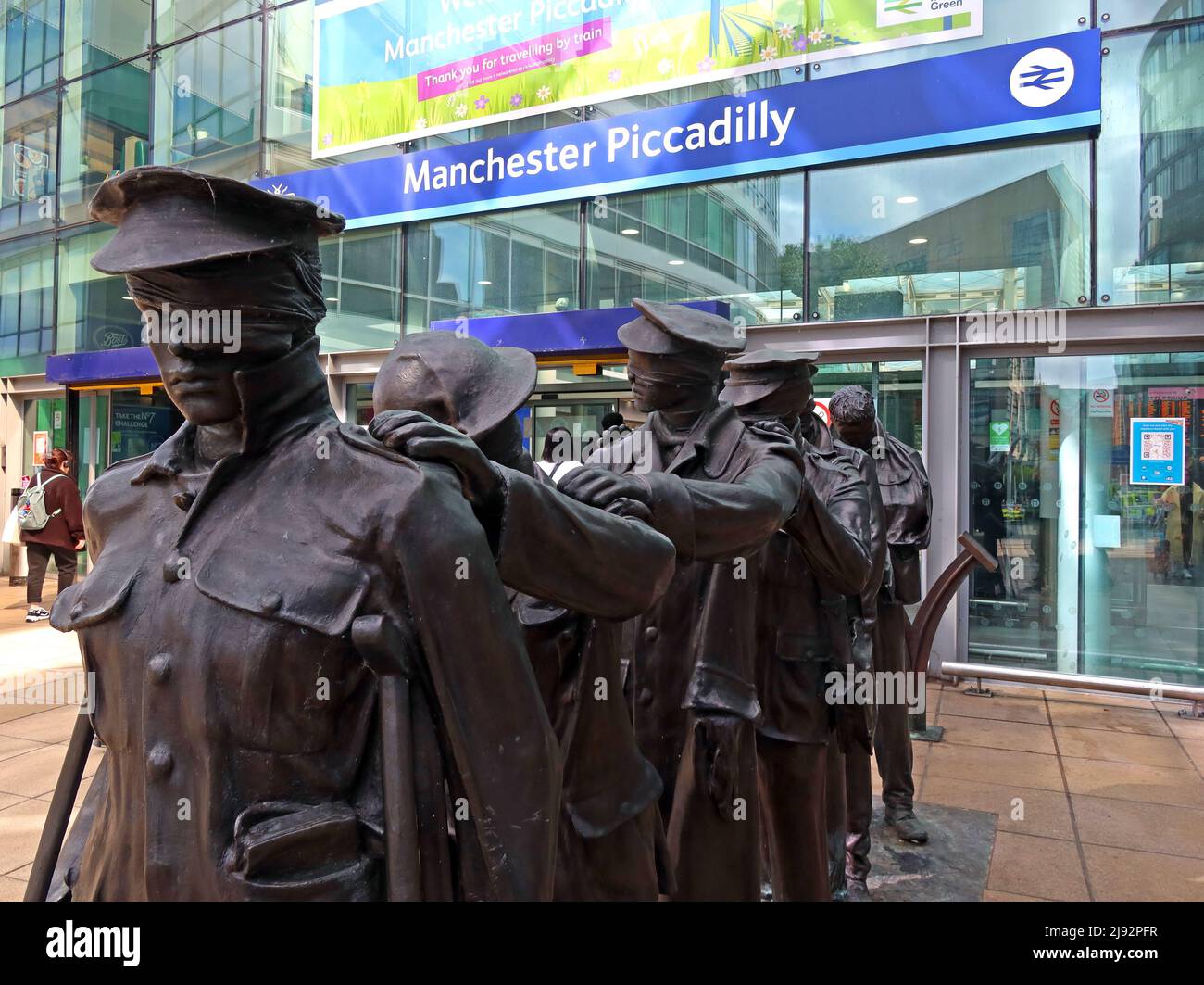
Image details
Contributor:
Tony SmithImage ID:
2J92PFRFile size:
50.8 MB (1.7 MB Compressed download)Releases:
Model - no | Property - noDo I need a release?Dimensions:
4872 x 3648 px | 41.2 x 30.9 cm | 16.2 x 12.2 inches | 300dpiDate taken:
13 May 2022Location:
Piccadilly Train Station Approach, Greater Manchester, England, UK, M60 7RAMore information:
Victory Over Blindness is a bronze sculpture in Manchester, England, by Johanna Domke-Guyot. It is on Piccadilly Approach outside the main entrance of Manchester Piccadilly station and was commissioned to commemorate the centenary of the First World War. The sculpture depicts seven blind figures guiding each other and walking together; their likeness are based upon real veterans who all suffered blindness as a result of action on the frontline. Unusually a plinth is not used and the figures are situated at eye level to engage passers-by. It was commissioned by the Blind Veterans UK and was unveiled in October 2018. It is believed to be the only memorial to depict those wounded in the First World War. The sculpture was first created to mark the centenary of the Blind Veterans UK charity in 2015 and which now sits at the charity's Llandudno rehabilitation and training centre. The sculpture depicts seven life-sized figures guiding one another. It was inspired by a photograph the sculptor saw of World War I veterans, blinded in combat, leading one another from the front. Whereas statues or sculptures of lifelike individuals are generally placed on plinths, it was decided the sculpture should be situated on the ground and at eye level to engage passers-by and to highlight the notion that the sacrifices of those on the frontline in World War I should not be forgotten. The sculptor, Johanna Domke-Guyot, stated that "People will be able to touch them, I want it to become a people's piece". The seven figures are all based upon World War I veterans who all suffered blindness as a result of action on the frontline and each figure depicts a similar likeness to the veterans. The sculpture was well-received with it being described as "moving" for its subject matter and "striking" for its interaction with passers-by at eye level

