World Photography Day falls on 19th August 2026 and we thought this would be a fantastic opportunity for our contributors to share with us their best ever shots!
Every month we choose our Photos of the Month along a theme but this time, we wanted to know which images our contributors are most proud of.
To get things going, we curated a collection showcasing our favourite 100 images from the last two years of POTM and we think it shows the great talent and diversity of our contributors.




Read on to see our favourite images and the stories behind them (in no particular order) from ‘Your Best Ever’ July POTM, all in the name of World Photography Day 2026.
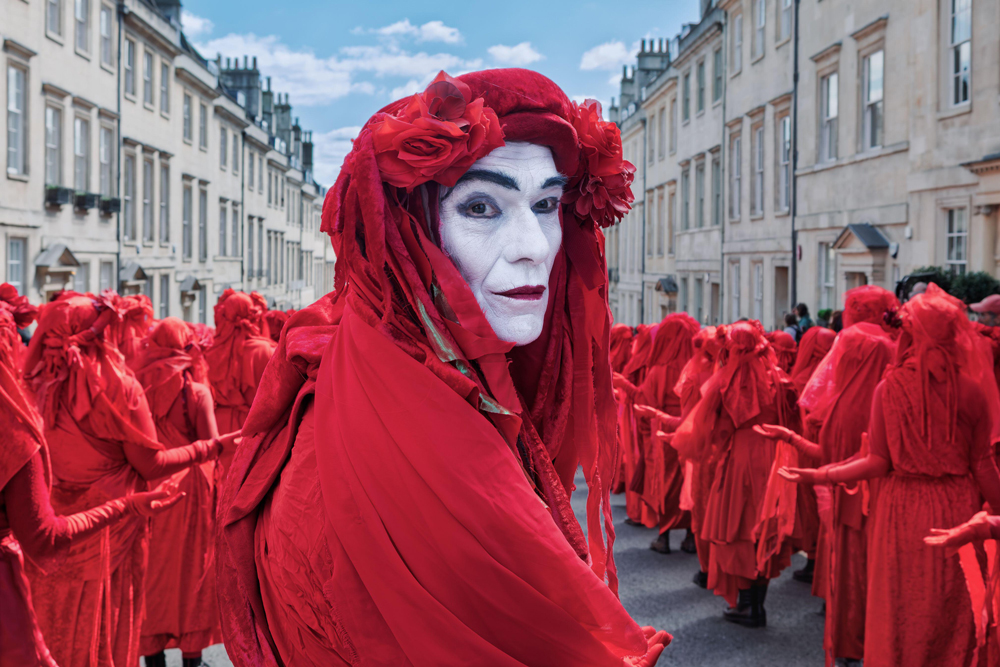
John Lynch: Members of the Red Rebel Brigade take part in a ‘funeral for nature’ procession in Bath, UK, the largest global assembly of the Red Rebel Brigade
Before covering an event, I like to do a bit of pre-visualisation, as I find this preparation incredibly helpful on the day. This particular image is my current favorite because virtually everything I had envisioned fell perfectly into place. I wanted to create a dynamic shot that contrasted the striking red robes of the Red Rebels with Bath’s famous Georgian architecture.
There was a big media presence that day, and whenever the procession stopped, it turned into a bit of a bunfight as photographers scrambled for the best position. As the group made its way up the hill toward the entrance of The Circus, photographers all gathered at the top to shoot the cortege coming up the hill towards them. However, when the lead Red Rebels reached the top of the hill, they turned around to face downhill to wait for the rest of the procession to catch up. Almost all the other photographers then rushed back down the hill to get shots looking upward.
Seeing this, I positioned myself directly behind the lead activist, knowing that the second he turned back around to lead the cortege forward, I would capture the exact frame I had pre-visualised. Compositionally, it couldn’t have worked out better, the two lines of red rebels and the buildings on each side of the road lead the viewer’s eye to the lead activist’s face.
Roy Waller: European otter on a rock in the middle of a river in a secluded valley
I would say this is my favourite image. Partly because the Eurasian otter is a shy, secretive and elusive animal and it’s iconic British wildlife, but also because it was taken in what for several years was my favourite place to be with a camera; a secluded and wooded river valley where it was rare to see other people. Apart from it being picturesque I enjoyed the solitude, and the sounds of the river and wildlife.
The story of this image is that I put some fish on a rock in the river expecting to get a shot of a mink which had a den nearby. I got nothing for hours and decided to return soon after sunrise the following day. When setting up my kit I spotted the otter coming downstream. I was still in plain view with no camouflage. I kept perfectly still and to my delight the otter climbed onto the rock and began to consume the still untouched fish. When the otter was comfortably feeding I slowly picked up my camera and took a few shots. Otters can’t see very well but they are not deaf. It immediately looked straight at me. I didn’t move a muscle. After a while it resumed feeding and I was able to get more shots. After consuming all the fish off it went, none the wiser of my presence.

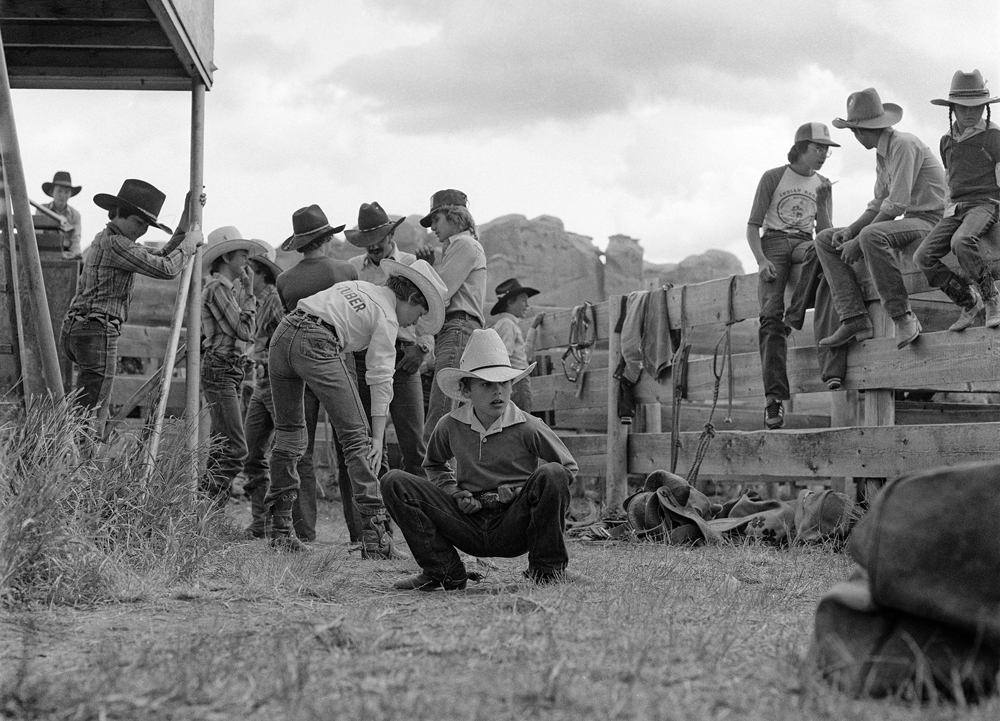
Rick Rudnicki: Behind the chutes at the Writing On Stone Rodeo. Vintage monochrome circa 1983
In the early 80s, I spent a lot of time photographing small Alberta rodeos, including Writing‑on‑Stone. I’ve always been drawn to the quieter moments in the background, so when I noticed a young cowboy stretching, I focused on him. It wasn’t until I looked at the contact sheet later that I realized there were other cowboys in the frame as well.
That print is framed and hanging on my office wall now, which probably makes it my favorite.
Michael ONeill: Closeup of a Sweat Bee Hold a Drop of Water and Drinking
I was shooting in a vineyard, when I came across this sweat bee holding a drop of water. I quickly changed lenses to a macro and fired off a few shots before the bee flew off. At first I wasn’t sure what the was in it’s mouth, as they are very tiny. Upon closer inspection I saw it was a dew drop from the leaf.

Sabena Jane Blackbird: Arbore Tribe Woman, Omo Valley, Ethiopia, Africa
I wasn’t sure whether to upload this – although possibly not one of my technically best shots – it’s one of many taken at that time which have continually resonated for me nostalgically – wow I actually did that! – this is a ‘moment in time’.
Taken in the Omo Valley in Ethiopia in 2006 on negatives and scanned (I couldn’t afford slide film) a month after Bruce Parry had finished filming his Tribe series for the BBC. I had a mere three weeks and he was working there for fourth months. He’s a top bloke though! I returned in 2011 with a DSLR, but it wasn’t the same experience unfortunately.
This is a shot of an Arbore Tribe woman. She was younger than I was at the time by about ten years and was surprised that I was older. She had recently given birth and stood with absolute defiance with her stance, eyes and attitude!

allanbellimages: Lincoln Cathedral from castle wall
It was a nice day to take some stock photos so I caught the local bus into Lincoln city. When I arrived I took the long walk up the High Street and Steep Hill to Lincoln Castle, which has a surrounding wall. There is a wall walk from which people can admire the scenery of upper and lower Lincoln city. There are some good views of Lincoln Cathedral from the wall walk and an even better view from the North East corner tower named “Cobb tower”. This also gives a bit more height above the wall walk.
After walking up to the top of “Cobb tower” I could see the marvellous view of the West wall and West towers of the Cathedral with the main centre tower to the Left of the West towers. In between there are a mishmash of old town buildings and the varied colours of the rooftops of the buildings making an interesting pattern.
The horizon can be seen to the right side of the Cathedral and trees to the left side. The low clouds give a bit of drama to the view with just a tad of blue sky to the left.
Lincoln Cathedral was consecrated in 1092 and has suffered structural damage in various forms throughout its history through earthquakes, fires and strong winds, always being rebuilt after.
The Cathedral, which can be seen from many miles away dominates Lincoln city and surrounding areas, is one of the main tourist attractions of the city.
The crunch line is that I do not like heights and always feel as though I am about to fall off to the ground below!

iWebbstock: RAF Mcdonnell Douglas Phantom FGR2 refuelling over the Falkland Islands 1989
This shot was taken in 1989 over the Falkland Islands from the back of a Hercules. There is no glass there, it’s open to the elements.
I had a real fear of dropping my camera (Pentax MX with possibly 50mm kit lens), the consequences don’t bear thinking about, but worth the effort.

Wim Wiskerke: Antony Gormley Exposure at sunset looking out over the IJsselmeer Lake Lelystad, Holland
My best shot is this one with the sunset through the huge Sir Antony Gormley sculpture. In interviews Gormley has talked about how he liked the idea that the man (it’s a self portrait) would be looking at the setting sun each day. So I wanted a shot with a setting sun.
When I drove up the first time around sunset, it was raining by the time I got there. It’s a one hour drive, and this is Holland after all, we get your UK weather the next day. The second time it became clear that the sun did not set anywhere near the sculpture in my frame.
This one was after getting the first (still desktop) app that showed where the sun and moon where on any given time and place. This image is near the summer solstice and I have another done near the winter solstice. This is with 2 cameras, so Photoshop was involved. I am standing 720m / 0.45 miles away; there are 2 canals and a breakwater in between. It was shot on a Canon 1Ds3 and 2 and those could never get the dynamic range anywhere near what was needed. Initially I hadn’t thought that would be a problem, but test shots revealed there was no way to get the color of the setting sun and the detail of the pylon structure in one go. Besides the sun moved to quickly to get it all aligned.
In the end I used two cameras very close to each other. One with a 80-200 and one with a 1200, both firing and bracketing like mad. The 1200 (actually an ancient 600 with an 2x extender) on the 1Ds2 on 2 tripods.
As the sun came closer it became clear my spot was off by about 20-30 meters. So I scrambled with the 3 tripods and all my gear to the perfect spot. Then in walked this dog inside my frame, followed by the couple and at the perfect moment they stood underneath the giant structure looking at the sunset! Holding hands! The dog is now just beyond the grass and invisible. The sun is from the long lens which revealed the beams.
It has been used in the Times Literary Supplement and for school exams among others.
When asked by the mayor of Lelystad about lights to make it more visible at night, Gormley said no on Dutch television: “It’s not an opera”.

Jill Morgan: Harris Hawk Catching Piece Of Chicken
I debated on which one to pick, as I have a few favourites, but this probably is the one. It took ages to get the shot and the absolute power yet fragility of these hawks and other raptors fascinates me. I have it framed on my wall.

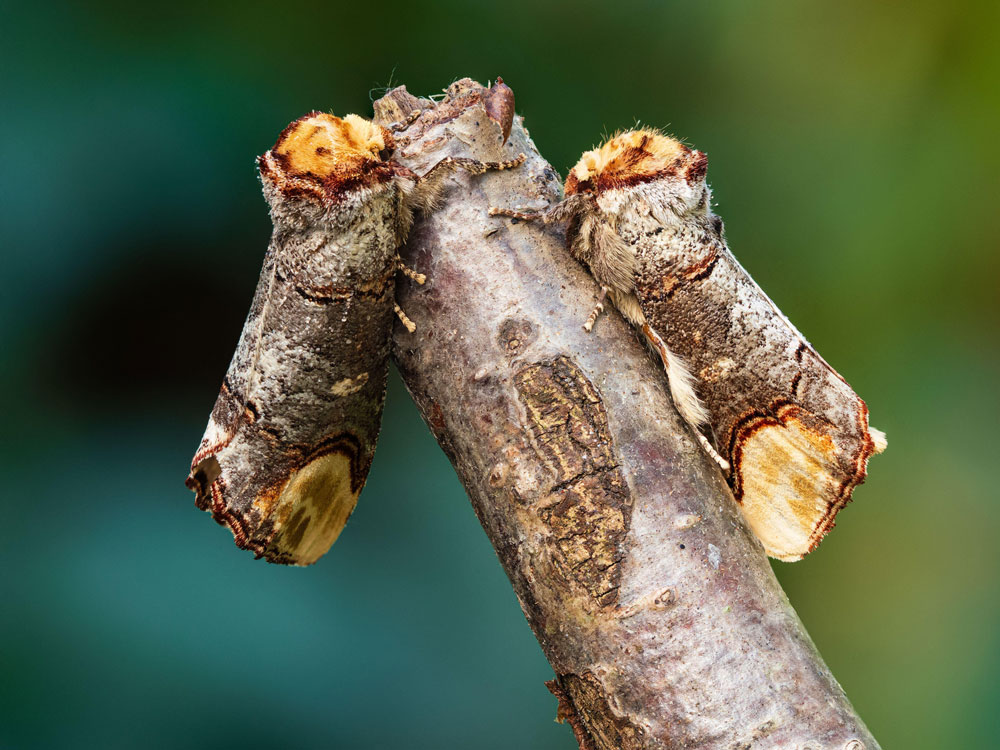
John Richmond: Two Buff-tip moths, camouflaged as silver birch twigs
In the end I couldn’t decide so I’ve gone for this very recent image as it’s representative of what I’ve learned and how my photography has developed during my time with Alamy.
I enjoy insect and other macro photography. I have a moth trap in my garden and a couple of nights ago I trapped a brace of Buff-tip moths. They’re known for their camouflage patterns that make them look like broken silver birch twigs. So I set up an appropriate twig and gently (I use a feather to avoid any damage to the moths) manipulated them into position on the twig.
The image is a 15 shot focus bracket to preserve every detail of the moths and twig while also generating a clean background from my garden vegetation. Natural light was used. Post-shooting the moths were placed in a suitable location to hide during the day.
I leave others to decide which is my ‘best’ photo but I feel this one is representative of where I am now and it’s one I’m pleased with.
Thank you to all our contributors who took the time to enter this month’s POTM and congratulations to all who made the top ten. As you can imagine, picking our favourite images out of all the entries for this special edition of Alamy’s Photo of the Month was not easy, especially when reading through all the interesting stories behind these images. Make sure to have a look at all the entries here – do you agree with our top 10?
If you’ve never been involved with our Photo of the Month before but would like to be, make sure you’re signed up to our marketing emails to receive each month’s theme. At the end of the month. we share our favourite entries with you, our customers and we also highlight our top 5 stand-out images over on our Instagram.
Finally, don’t forget to get involved with this year’s World Photography Day!